
Reviewed · KHIVA TOURS
Khiva day tour
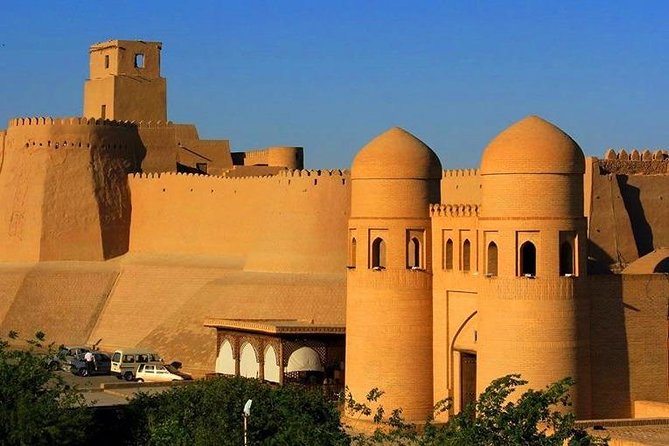
Khiva’s old city is a compact maze of blue tile, mud-brick walls, royal courtyards, and towering minarets. This private tour gives you a clear route through Itchan-Kala, the UNESCO-listed fortress where nearly every turn leads to another piece of Central Asian history. I like the early 8:00 am start and the way the guide can adjust the talk to your interests. The main drawback is that entrance fees are not included, so the $60 price is not the full cost.
I also like the five-to-six-hour pace. You have enough time to see the major sights without racing from one doorway to the next, and the air-conditioned transport is useful on a hot day. Khiva rewards careful looking, but this is still a long morning on foot, with plenty of information to absorb.
Key points at a glance
- Itchan-Kala is the main event: Nearly the entire tour takes place inside Khiva’s walled UNESCO site.
- The route covers major landmarks: See Kalta-Minor, Kunya-Ark, Juma Mosque, Tash-Khovli Palace, several madrasahs, and two important mausoleums.
- A private guide shapes the experience: Only your group participates, so the commentary can follow your questions and interests.
- Charos is one named guide to look for: Her tour was praised for staying on time, covering the full route, and adapting to the group.
- The start is early and practical: Meet at 8:00 am at Itchan-Kala, Boltaeva-41, with the tour ending back at the same meeting point.
- Budget for entrance charges: Admission tickets, taxes, and personal expenses are separate from the $60 tour price.
Why Itchan-Kala deserves a guided morning
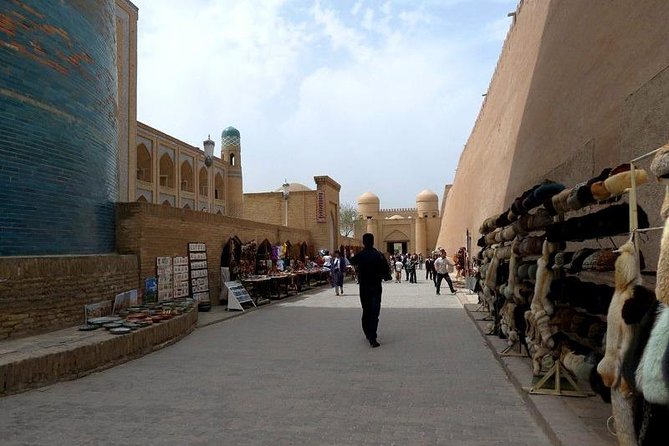
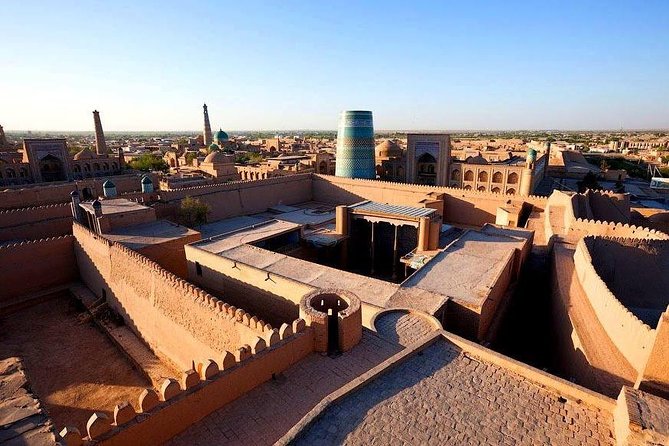
Khiva can look almost unreal at first. Inside the old city walls, tall minarets and turquoise tile rise above narrow lanes, while richly decorated facades line streets that feel made for slow walking. The appeal is not just a single grand building. It is the concentration of mosques, palaces, schools, defensive walls, and mausoleums in one walkable historic quarter.
That concentration is also the challenge. Without context, you can admire the tilework and monumental doors but miss how the buildings worked together as a political, religious, and commercial center. A guide helps turn a collection of beautiful facades into a readable town.
This tour is particularly useful on your first morning in Khiva. You get an overview of the old city, learn which monuments deserve a second look, and gain enough background to explore on your own afterward. The private format matters here. If you are curious about architecture, dynasties, religion, or local legends, you can ask instead of waiting for a standard group explanation.
The strongest praise for this experience centers on the guides. Charos was described as punctual, thorough, and sensitive to what interested her group. Another guide was praised for keeping the day relaxed while explaining a great deal. That combination is important in Khiva, where a rushed tour can leave you with a blur of names and dates.
Other Khiva days people book alongside this one:
- Transfer: Bukhara – Khiva via Ancient Fortresses
★ 4.5 · 101 reviews - Daytrip From Khiva To Ancient Fortresses
★ 4.6 · 60 reviews - Aral Sea Adventures (2 day)
★ 5.0 · 30 reviews
Kalta-Minor and the two grand madrasahs
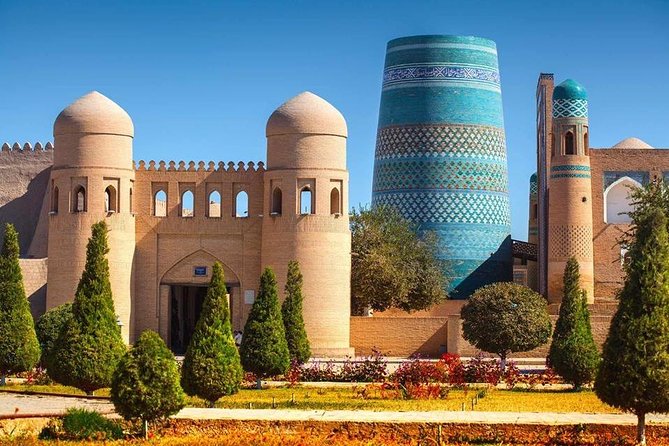
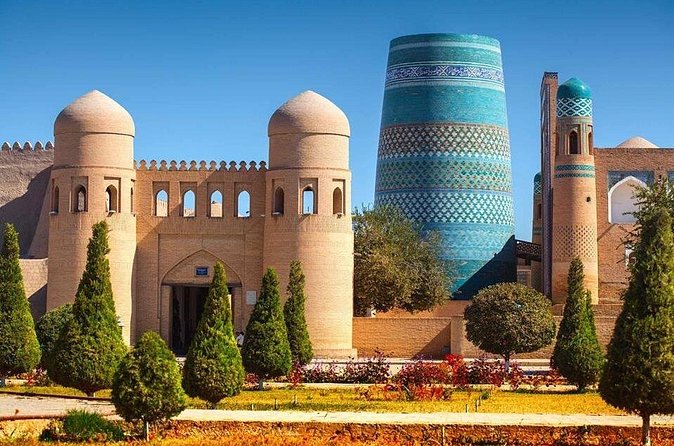
Kalta-Minor is one of Khiva’s most recognizable sights. Its broad, turquoise-clad form was intended to become a much taller minaret, but construction stopped before the plan was completed. The result is unusual: instead of the slender tower you may expect, you see a short, powerful cylinder covered in tile.
It makes an excellent first lesson in Khiva’s architecture. The monument is easy to photograph, but your guide can explain why it was built and how it fits into the ambitions of the city’s rulers. The surrounding area also gives you an immediate sense of Itchan-Kala’s scale.
The Mukhammad Aminkhan Madrasah dates from 1851 to 1854. Madrasahs were religious schools, but they were also important public buildings, with student rooms, teaching spaces, and formal facades. Look closely at the repeated decoration and the balance between the large entrance portal and the smaller surrounding details.
The Mukhammad Rahimkhan Madrasah dates from 1876. Seeing these two schools in the same tour lets you compare different periods of Khiva’s building tradition. You do not need to memorize every date. I find it more useful to notice how each building presents authority through size, symmetry, and ornament.
These early stops are also a practical orientation. They place you near the main spine of Itchan-Kala and help you understand that the old city is more than a preserved backdrop. It was designed for education, worship, government, residence, and ceremony.
Kunya-Ark, where Khiva’s rulers worked and lived
Kunya-Ark means the old fortress, and it served as the citadel of Khiva’s rulers. Its buildings date across the seventeenth to nineteenth centuries, so this stop lets you see how the ruling center developed over time.
The value of Kunya-Ark is its range. It was not simply a palace with one grand reception room. A citadel brought together official business, defense, court life, and private quarters. As you move through the complex, the guide’s explanation helps you understand the difference between a ceremonial space and a working part of the fortress.
This is one place where a private tour can feel more useful than a simple sightseeing walk. You can ask how the khan’s court operated, what the fortress protected, or why its position mattered inside the city. The supplied information does not promise every room or building will be open on the day, so treat the visit as a guided look at the complex rather than a guarantee of access to every interior.
The fortress also adds a political layer to the morning. Khiva’s monuments are not all devotional buildings. Kunya-Ark shows you how power was organized and displayed, which makes the later palace visit easier to understand.
Juma Mosque and Khiva’s forest of columns
Juma Mosque, dating from the eighteenth century, offers a different mood from the tile-covered facades outside. Its interior is known for a large number of wooden columns, creating a quiet, shaded space with a strong rhythm as you look across the prayer hall.
The contrast is worth noticing. Khiva is famous for blue tile and monumental portals, but Juma Mosque shows the importance of wood, shade, and repeated structural forms. The building feels less like a single grand image and more like a carefully ordered interior.
This is a good point to slow down. A guide can explain the mosque’s religious function and help you pay attention to details that are easy to pass over, such as the column shapes, spacing, and sense of proportion. The tour’s five-to-six-hour duration gives you room for that pause.
As with the other religious sites, dress and behavior should be respectful. The tour information confirms the mosque as part of the route, but it does not specify current visiting rules or whether services affect access. Your guide can address practical questions on the day.
Same Silk Road, a completely different kind of day:
- Khiva Historical City Highlights Guided Walking Tour
★ 5.0 · 30 reviews - Guided Tour To Old Fortresses
★ 5.0 · 25 reviews - Private Daytrip to 7 Ancient Fortresses of Khorezm
★ 5.0 · 25 reviews - Tranfer Khiva – Bukhara via Ancient Fortresses
★ 4.8 · 24 reviews
Tash-Khovli Palace and the courtly side of Khiva
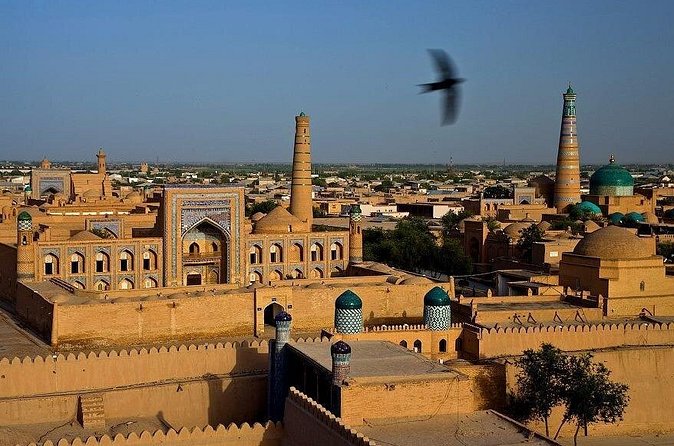
Tash-Khovli Palace, built in the nineteenth century, brings you into the world of royal residence and ceremony. The name means stone house, and the complex is known for courtyards, reception areas, and detailed tile decoration.
The palace is valuable because it balances Kunya-Ark. The citadel shows the machinery of rule, while Tash-Khovli helps you picture the formal and residential side of court life. Courtyards were not just pretty open spaces. They organized movement, separated functions, and framed the decorated rooms around them.
Take your time with the tile patterns and carved details. The best guide commentary here should connect decoration to purpose, explaining who used each area and how the palace reflected the status of its residents. One of the most useful qualities mentioned about the guiding is the ability to focus on what interests you. If interiors and design matter more to you than military history, say so early.
The palace can also be one of the busier-feeling parts of a popular old-city route, depending on the day. The early start helps, but the tour does not promise that every site will be quiet. That is a fair trade for seeing Khiva’s best-known buildings in a single morning.
Pakhlavan Makhmud Mausoleum and the spiritual heart of the city
The Pakhlavan Makhmud Mausoleum dates from 1701 and honors Pakhlavan Makhmud, a major figure in Khiva’s religious and cultural tradition. Mausoleums in Central Asia often combine remembrance, pilgrimage, craftsmanship, and local identity, so this is more than another decorated building.
The interior decoration deserves careful attention. Tilework, inscriptions, color, and light create a different experience from the open palace courtyards. You may find the atmosphere quieter and more reflective, even though it is part of a busy sightseeing route.
This stop also gives your guide room to explain the person behind the monument. The supplied tour details do not provide a full biography, so I would listen for the local traditions and stories your guide chooses to share rather than expecting a fixed lecture.
Respectful clothing and behavior are sensible at a mausoleum. Current access rules are not specified, and religious sites can have special conditions, so keep your schedule flexible.
Islam-Khoja Minaret and the final high point
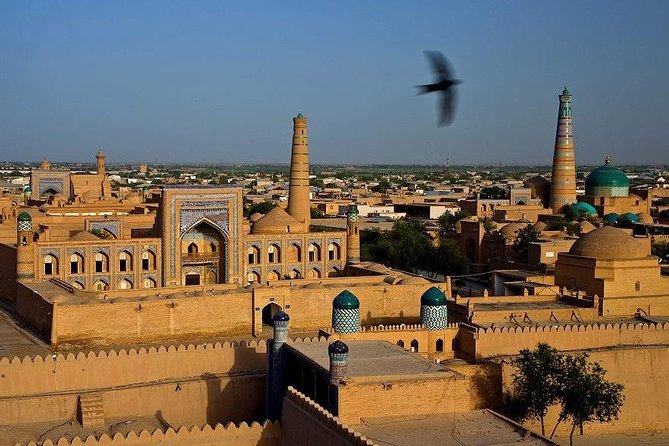
The Minaret of Islam-Khoja is a nineteenth-century landmark and one of the defining vertical features of Khiva. Its height and narrow profile make a sharp contrast with the broad shape of Kalta-Minor.
Even if you do not climb it, the minaret helps you understand the old city from ground level. Khiva’s towers were practical and symbolic. They marked the skyline, supported the call to prayer, and announced the presence of an important religious and political center.
The tour description names the minaret but does not state that climbing is included or available. Do not book this experience expecting a guaranteed climb. The safe assumption is that you will see the monument and receive an explanation as part of the walking route.
By this point, the different parts of Itchan-Kala begin to fit together: schools and mosques, royal buildings and defensive spaces, mausoleums and skyline markers. That is the real strength of a guided visit. You are not only collecting photographs. You are learning how the city’s parts relate to one another.
What the $60 price really covers
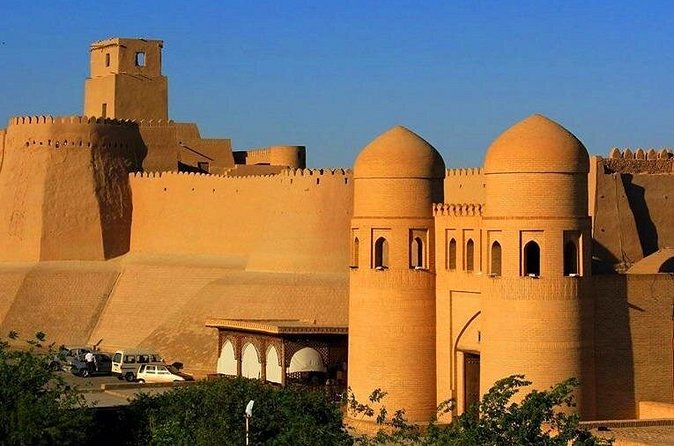
At $60 per person, the tour sits in a reasonable range for a private half-day experience, especially if you are traveling with companions who value a dedicated guide. The price includes a professional guide, bottled water, and comfortable air-conditioned transportation.
The private format is the biggest value point. Only your group takes part, so you do not have to follow the pace of strangers or listen to long explanations about subjects that do not interest you. Group discounts are offered, which may improve the cost for a larger party.
The price does not include admission tickets, taxes, other fees, or personal expenses. That matters because the route includes several major monuments. Before booking, ask the provider how much you should set aside for entrance charges on your chosen date.
The included transport may not be the main cost saver, since Itchan-Kala itself is explored largely on foot. Its value is comfort, especially in hot weather, and convenience if transport is needed around the experience. The tour includes bottled water, but you may still want extra water and sun protection for a long morning outside.
The experience is often booked about 36 days ahead. That does not guarantee it will sell out, but it is a useful sign to plan early if your dates in Khiva are fixed.
Timing, meeting point, and pace
The tour starts at 8:00 am at Itchan-Kala, Boltaeva-41, in Khiva. It ends back at the same meeting point, and the full experience lasts about five to six hours.
An early start is a real advantage. Khiva can become hot, and the morning gives you a better chance of walking before the strongest heat. It also creates a natural rhythm: major monuments first, explanations along the way, then a return to the meeting point before the day gets too far along.
The pace has been described as thorough without feeling rushed. That is exactly what I would want here. Itchan-Kala contains a lot to see, and a guide who skips buildings to save time would undermine the reason for booking.
Pickup is offered, but the stated start point is Itchan-Kala. Confirm the exact pickup arrangement when you book, especially if you are staying outside the old city. The activity is near public transportation, and confirmation is sent at booking.
Free cancellation is available if you cancel at least 24 hours before the local start time. Changes or cancellations made less than 24 hours ahead are not accepted for a refund. The experience also requires a minimum number of participants, and if that minimum is not reached, you are offered another date or experience, or a full refund.
Who should book this Khiva tour?
I would choose this tour if you are visiting Khiva for the first time and want the old city explained in a sensible order. It suits couples, families, and small groups who prefer to ask questions and set the pace rather than join a large group.
It is also a strong choice if you have limited time. In five to six hours, you can cover the main monuments of Itchan-Kala with a guide, then return to places that caught your attention. The early start works well for a full sightseeing day.
History and architecture fans will get the most from the route, but you do not need specialist knowledge. The buildings themselves are impressive. The guide’s job is to connect them to the people, institutions, and beliefs that shaped Khiva.
I would think twice if you want a completely independent wander with no fixed structure. This is a focused cultural tour, and the entrance fees are extra. It is also not a light, short photo stop. You should be comfortable spending much of a morning walking and listening.
Should you book it?
Book this Khiva tour if you want a well-paced introduction to Itchan-Kala, a private guide, and coverage of the city’s essential monuments. The strongest reasons are the flexible guiding, early start, air-conditioned transport, and the chance to see Khiva’s religious, royal, and educational buildings in one coherent morning.
Before paying, confirm the entrance costs and pickup details. If those extras fit your budget, the $60 price offers good value for a private experience that gives Khiva some much-needed context. Charos is a guide name worth requesting if she is available, particularly if you value a punctual and adaptable approach.
FAQ
How long does the Khiva day tour last?
The tour lasts approximately five to six hours.
What time does the tour start?
The stated start time is 8:00 am.
Where does the tour begin and end?
It begins at Itchan-Kala, Boltaeva-41, 220900, Khiva, and ends back at the meeting point.
Is this a private tour?
Yes. Only your group participates in the activity.
Are entrance tickets included?
No. Admission tickets, taxes, other fees, and personal expenses are not included.
What is included in the tour price?
The price includes bottled water, a professional guide, and comfortable air-conditioned transportation.
Just added around Khiva
- Traditional Khiva Cooking Class with Market Visit & Lunch★ 5.0 · 4 reviews
- Old Khiva Stories with Your Local Guide★ 5.0 · 5 reviews
- A Night In The Kyzylkum Desert [2] From Khiva★ 4.5 · 3 reviews
- Master Class – Uzbek Bread (Khiva)★ 3.5 · 4 reviews
- Aral Sea – Extended trip (3 days)★ 5.0 · 5 reviews
- Khorezm Fortress and KyzylKum Desert Private Tour★ 5.0 · 3 reviews
- Best of Khiva: Exclusive Private Tour!★ 5.0 · 3 reviews
- Uzbekistan 6 Days Private Tour Khiva-Bukhara-Samarkand by Train★ 5.0 · 4 reviews
Khiva Tours, compared.
Khiva Historical City Highlights Guided Walking Tour
Read our review →
Daytrip From Khiva to Aral Sea Cemetery Of Ships . All In One
Read our review →Browse the lists this tour appears in