
Reviewed · GUIDED
Old Khiva Stories with Your Local Guide
Khiva’s old city is best understood on foot, and this tour takes you straight into Itchan Kala, the walled UNESCO center where minarets, madrassahs, palaces, and caravan stops crowd together. Local guide Sarvar brings in Khivan legends, family connections, and practical advice about eating and shopping.
I like the broad route, which covers major sights such as Kalta Minor, Kunya Ark, Juma Mosque, and Tash Khauli Palace in about three hours. I also like the local touches, especially the wood-carving workshop and the discussion of Central Asian scholars. The main catch is cost: the $22 guide fee does not include the 250,000-sum admission ticket.
Key points to know before booking
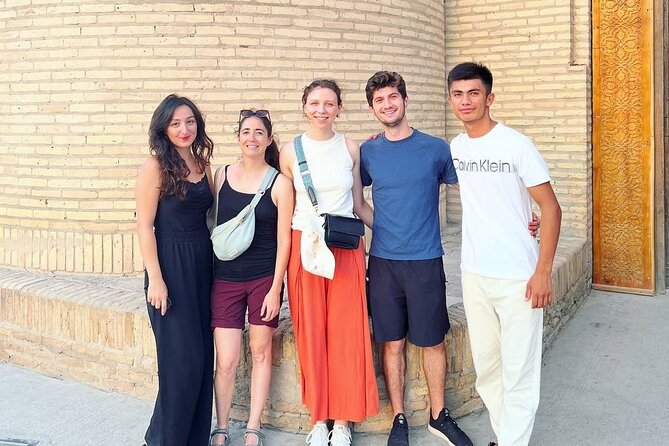
- A Khiva-born guide: Sarvar grew up in Khiva and leads the walk in English, with stories about local life as well as rulers and monuments.
- Ten useful stops: The route links gates, madrassahs, palaces, a mosque, a museum, a craft workshop, and a former caravan market.
- Admission is extra: The 250,000-sum ticket covers 10 to 13 museums, and you can pay by cash or card.
- A compact old-city route: The walk lasts about three hours and begins and ends at the west gate of Itchan Kala.
- Small group size: The maximum is 15 people, so this is more personal than a large coach tour.
- A practical introduction: Sarvar also offers suggestions for food, shopping, and further exploring during your stay.
Why a local walk makes sense in Khiva
Khiva can look simple at first glance. The old city is compact, and many grand buildings sit within a short walk of one another. Yet the closer you look, the more questions appear. Why was Kalta Minor left unfinished? What happened inside the khan’s fortress? Why does Juma Mosque have so many wooden columns?
A guide gives those buildings a human frame. Sarvar was born and raised in Khiva, and he has worked as a guide since 2018. That matters here because the city is not only a collection of restored facades. It was a court, a trading center, a religious center, and a working neighborhood.
The tour is built around stories rather than a fast march from one photo stop to the next. Sarvar explains Khiva’s connection to Silk Road trade, the city’s khans, local traditions, and major scholars from Uzbekistan. His English is described as excellent, and his manner as kind, friendly, and entertaining.
That combination suits you if you want context without signing up for a full-day lecture. It also helps if you have limited time in Khiva and want an organized introduction before exploring on your own.
A few more Khiva trips to weigh up
- Khiva Historical City Highlights Guided Walking Tour
★ 5.0 · 30 reviews - Guided Tour To Old Fortresses
★ 5.0 · 25 reviews - Samarkand: Historical Monuments Guided Walking Tour
★ 4.8 · 446 reviews
Starting at Ata Darwaza and Mohammed Amin Khan Madrassah
The walk begins at Ata Darwaza, the west gate of Itchan Kala. This was a major entrance for caravans and traders moving through the old city, so it is a fitting place to begin. You get your bearings at the walls before moving into the maze of lanes inside.
The opening stop is short, about 10 minutes, but it sets the scene. Sarvar can explain how the gate functioned and how Khiva fitted into long-distance trade routes. Since the tour begins and ends here, you can easily continue your own sightseeing afterward without arranging a second meeting point.
Next comes Mohammed Amin Khan Madrassah, built in 1851. It was once the largest Islamic school in the region, with room for more than 250 students. Even if you are not an architecture specialist, the building helps explain how education and religion shaped daily life in the khanate.
The planned visit lasts about 15 minutes. That is enough for a clear introduction, though not a slow architectural study. If you want detailed time inside every building, the group format and three-hour limit may feel brisk.
Kalta Minor, Khiva’s unforgettable turquoise landmark
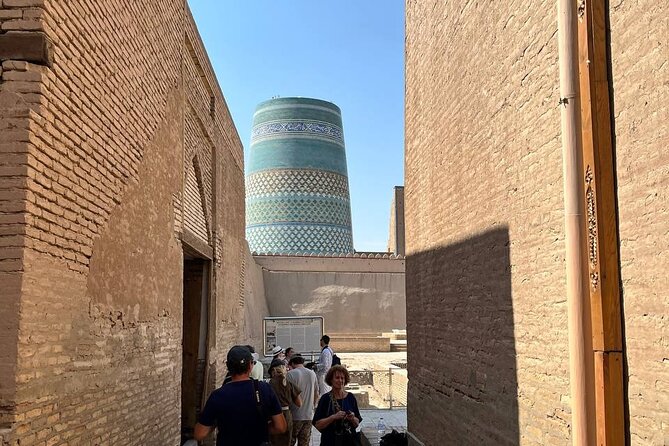
Kalta Minor is beside the madrassah and is likely to become your first favorite sight. Its turquoise tilework and unusually broad, short form make it unlike the tall, slender minarets found elsewhere in Central Asia.
The story behind its shape is part of its appeal. Muhammad Amin Khan intended it to be much taller, but construction stopped before the project was finished. Sarvar uses the monument to connect Khiva’s ambition with the ruler who commissioned it.
The stop lasts around 10 minutes. That may sound brief, but Kalta Minor is easy to view from nearby spaces, and the key value here is learning the story rather than spending a long period inside. You will also have time later to return for your own photographs.
Kunya Ark, the khans’ fortress within the city
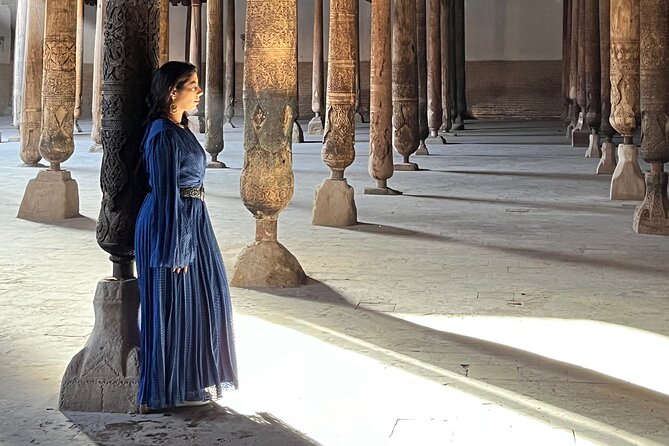
Kunya Ark was the residence of Khiva’s khans, and it is one of the tour’s most important stops. This was not simply a defensive wall. The complex included a throne room, harem, mint, mosque, and reception spaces.
You spend about 25 minutes here, the longest scheduled visit on the route. That is useful because the fortress contains several different functions and requires more explanation than a single facade. Sarvar can show how royal life, government, religion, and money-making operated within one compound.
The drawback is that 25 minutes still gives you an overview, not an exhaustive visit. The tour aims to cover much of Itchan Kala, so you should not expect a long, unhurried examination of every room. If the fortress becomes your main interest, you may want to return later with the admission ticket.
Same Silk Road, a completely different kind of day:
- Transfer: Bukhara – Khiva via Ancient Fortresses
★ 4.5 · 101 reviews - Daytrip From Khiva To Ancient Fortresses
★ 4.6 · 60 reviews - Aral Sea Adventures (2 day)
★ 5.0 · 30 reviews - Private Daytrip to 7 Ancient Fortresses of Khorezm
★ 5.0 · 25 reviews
Khiva’s wood-carving tradition
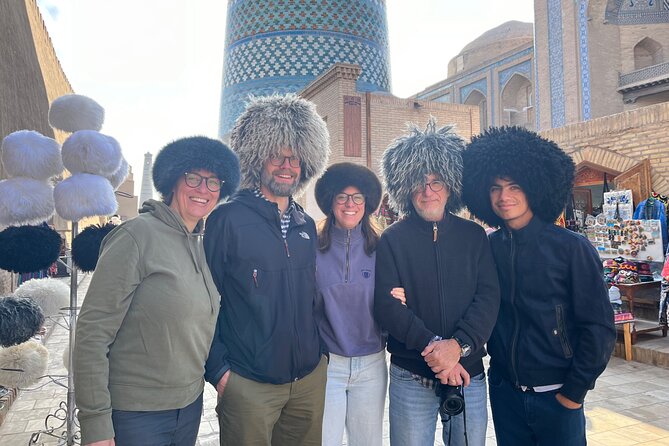
The wood-carving stop adds a welcome change of pace. Khiva is known for carved wooden columns, doors, and souvenirs, and at the workshop you can see the craft at close range.
This is one of the most useful parts of the walk for anyone who wants more than photographs of old buildings. You get a look at a living skill passed from one generation to the next. It also gives you a better eye for the carved details you will see in mosques and palaces.
The visit lasts about 15 minutes. The information does not specify that a purchase is required, so think of it as a craft demonstration and a chance to browse. If you shop, take your time comparing objects and asking about the work, rather than treating the stop as a quick souvenir break.
Scholars Museum and Uzbekistan’s wider story
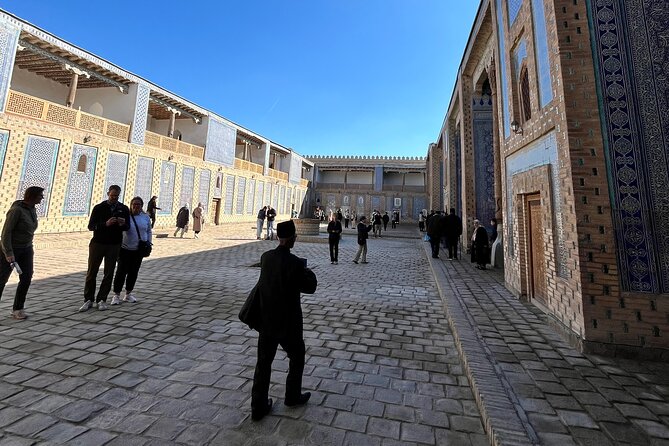
The Scholars Museum shifts the focus from buildings and rulers to ideas. Sarvar discusses figures connected with Uzbekistan who contributed to world civilization, including Al-Khwarizmi, Al-Biruni, Zamakhshari, and Avicenna, also known as Abu Ali Ibn Sina.
This is a valuable addition because Khiva can easily be reduced to tiles, towers, and royal rooms. The museum offers a broader view of the region’s intellectual life. You get a reminder that Central Asia produced important work in mathematics, science, language, philosophy, and medicine.
The scheduled time is 15 minutes. It is enough for a guided introduction, but your experience will depend on how much detail Sarvar covers and how much time the group spends looking at the displays.
Tash Khauli Palace and the price question
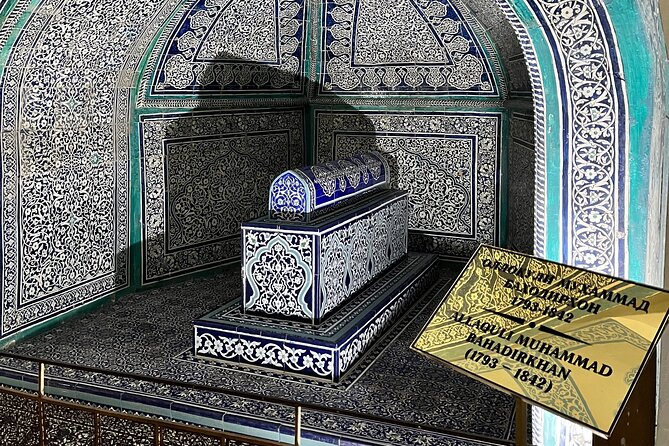
Tash Khauli, also called the Stone Palace or Allakulikhan Palace, was a nineteenth-century residence for the khans and their court. Its purpose was different from Kunya Ark, and seeing both helps you compare two royal settings within Khiva.
The stop is planned for about 15 minutes. This is one of the places where the admission charge matters. The general entrance fee is not included in the $22 tour price, and the details specifically identify Tash Khauli and the Islom Khodja Complex as places where admission is not included.
The stated museum ticket costs 250,000 sum per person and covers 10 to 13 museums. You can pay by cash or card. The package therefore needs to be judged as a guided walk plus a separate attraction pass, not as a $22 all-inclusive visit.
That is still a reasonable arrangement if you plan to see several museums. The ticket may offer good value for a full stay in Khiva, but it is less attractive if you only want to walk outside and photograph the monuments. Check the current exchange rate and confirm the local ticket details when you arrive.
Allakuli Khan’s caravan market
The Allakuli Khan Tim Market and caravanserai connect Khiva’s royal story with its commercial past. A caravanserai served as a stopping place along the Silk Road, and this preserved site gives you a sense of the trade network that brought people and goods through the city.
You will have about 15 minutes here. The stop includes time for shopping and local souvenirs, so it is practical as well as historical. I like this part of the route because it places Khiva’s grand architecture in everyday economic life. The city was not only a court for khans. It also needed markets, lodging, workshops, and merchants.
The short timing means you may need to return if you want to shop carefully. Use the tour to learn where the market is and what kinds of local products are available, then come back later if you find something worth considering.
Juma Mosque and its forest of columns
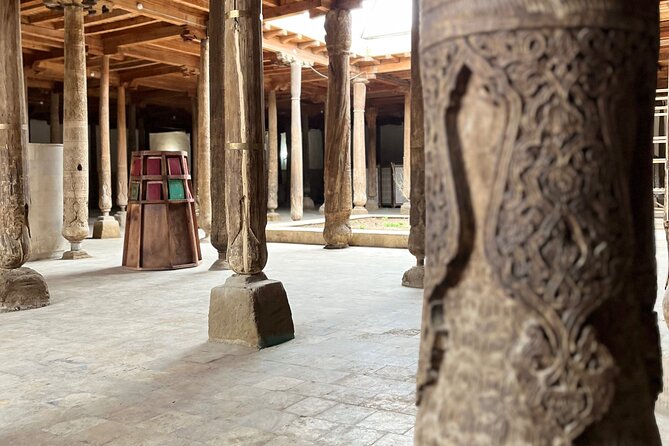
Juma Mosque is among Khiva’s most distinctive buildings. The mosque is known for 215 carved wooden columns, creating a quiet interior unlike the open courtyards and brightly tiled facades elsewhere in Itchan Kala.
The scheduled visit lasts 20 minutes. That gives Sarvar time to explain the mosque’s design and the mixture of Islamic and local artistic elements. It also gives you a chance to slow down after several palace and market stops.
This is a place where a guide’s explanation adds real value. A room filled with columns can be visually striking, but the details are easy to overlook without someone pointing out how the woodwork, spacing, and older architectural traditions fit together.
Islom Khodja Complex and the tallest minaret
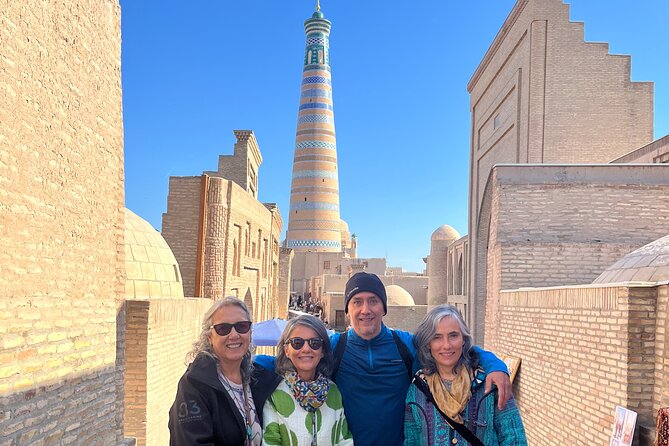
The final major stop is the Islom Khodja Complex, built in the nineteenth century and named after Islom Khodja, an important figure in Khiva. The complex includes a madrassah and the city’s tallest minaret.
The visit lasts about 15 minutes, and admission is not included. If climbing the minaret is part of your personal plan, confirm the current access arrangements and extra cost locally, because the provided tour details do not promise a climb.
The complex makes a strong ending because it returns you to Khiva’s vertical landmarks after the low lanes, courtyards, and palace rooms. You finish with a final architectural reference point before walking back to the west gate.
How good is the value at $22?
At $22 per person, the tour is fairly priced for a three-hour private-style introduction led by a local English-speaking guide, especially with a maximum group of 15. You are paying for interpretation, organization, and local advice, not transportation or entry tickets.
The separate admission fee is the key budget detail. Add 250,000 sum per person for the museum pass, then consider that it covers 10 to 13 museums. If you use the pass for several sites, the total cost makes more sense. If you plan to see only the streets and exterior views, the extra fee may influence your decision.
The route also saves time. You do not need to work out the order of the sights, find each building, or guess which palace or museum deserves attention. Sarvar can also suggest places to eat, shop, and continue exploring, which may help you get more from the rest of your stay.
Group size, timing, and practical details
The tour lasts approximately three hours and accepts no more than 15 people. That is small enough for questions, though the feel will depend on how many people actually book your departure.
The listed stop times add up to roughly three hours, so expect a steady walking pace. Wear comfortable shoes and bring water, especially if you visit in warm weather. The details do not state how much time is set aside for breaks, so do not count on a long café stop during the guided portion.
You receive confirmation when booking, and the activity uses a mobile ticket. The meeting point is the west gate of Itchan Kala, listed as Ata Darwaza at 99H4+CRQ, Khiva, Xorazm Region. The walk returns to the same place.
The experience is near public transportation, and most people can take part. No special accessibility details are provided, so ask before booking if you need specific assistance with uneven surfaces, steps, or palace interiors.
Free cancellation is available if you cancel at least 24 hours before the start time. Within 24 hours, you should expect no refund, and changes made that late are not accepted.
Who should book this Khiva walking tour?
I would choose this tour if you are visiting Khiva for the first time and want a strong orientation to Itchan Kala. It suits anyone who prefers a real person explaining the city rather than reading short labels at each monument.
It is also a good fit for people interested in local culture. The craft workshop, market, scholar discussion, and advice on food and shopping add range to a route that could otherwise focus only on palaces and photographs.
Families and mixed-interest groups may appreciate Sarvar’s friendly, entertaining approach. The maximum group size keeps the experience from becoming a large crowd, though the schedule remains fairly full.
I would be more cautious if you want a slow photography walk or hours inside one palace. Ten stops in three hours means you will see a lot, but some visits are introductions rather than detailed studies. You may need to revisit your favorite sites afterward.
Should you book Old Khiva Stories?
Book it if you want a well-organized first look at Itchan Kala with a Khiva-born English-speaking guide. Sarvar’s background, experience since 2018, and reported strength in explaining Uzbekistan’s history and culture make the human side of the tour its main asset.
Budget for the 250,000-sum admission fee, and remember that this fee covers a broad group of museums. The $22 price is good for the guide and route, but it is not the final cost.
My practical choice would be to take the walk early in your Khiva stay. You can learn the city’s layout, hear which sights deserve more time, and use Sarvar’s suggestions for your remaining meals and sightseeing. If you want an efficient, personal introduction rather than a slow specialist tour, this is a sensible booking.
FAQ
Where does the tour begin?
The tour begins at Ata Darwaza, the west gate of Itchan Kala in Khiva. The listed location is 99H4+CRQ, Khiva, Xorazm Region, Uzbekistan.
Where does the tour end?
The activity ends back at the meeting point, at the west gate of Itchan Kala.
How long does the experience last?
The walking tour lasts approximately three hours.
Who leads the tour?
The tour is led by Sarvar, a local guide born and raised in Khiva. He speaks English and has worked as a guide since 2018.
What is included in the $22 price?
The price includes an English-speaking guide. It does not include attraction admission.
How much is the entrance ticket?
The entrance fee is 250,000 sum per person. It includes entry to 10 to 13 museums, and payment can be made by cash or card.
Is the group private?
The tour is not described as private. The maximum group size is 15 people.
Is a mobile ticket available?
Yes. The experience features a mobile ticket, and confirmation is received at the time of booking.
Is the tour close to public transportation?
Yes. The meeting area is near public transportation.
Can I cancel for a full refund?
Yes, if you cancel at least 24 hours before the experience start time. Cancellations or changes made within 24 hours are not accepted for a refund.
Just added around Khiva
- Traditional Khiva Cooking Class with Market Visit & Lunch★ 5.0 · 4 reviews
- A Night In The Kyzylkum Desert [2] From Khiva★ 4.5 · 3 reviews
- Master Class – Uzbek Bread (Khiva)★ 3.5 · 4 reviews
- Aral Sea – Extended trip (3 days)★ 5.0 · 5 reviews
- Khorezm Fortress and KyzylKum Desert Private Tour★ 5.0 · 3 reviews
- Best of Khiva: Exclusive Private Tour!★ 5.0 · 3 reviews
- Uzbekistan 6 Days Private Tour Khiva-Bukhara-Samarkand by Train★ 5.0 · 4 reviews
- Ayaz Kala & Toprak Kala private fortress daytrip from Khiva★ 3.5 · 6 reviews
Guided, compared.
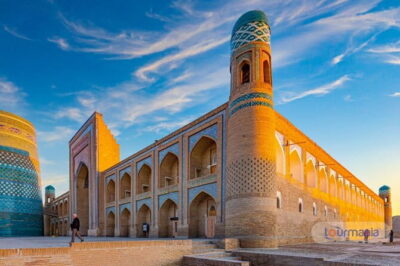
Khiva Historical City Highlights Guided Walking Tour
Read our review →
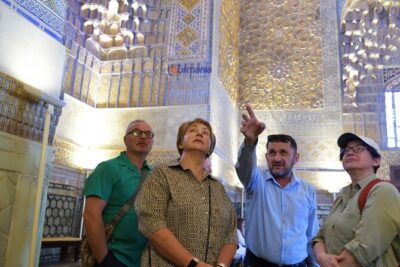
Samarkand Historical City Highlights Guided Walking Tour
Read our review →
Private Guided Tour Samarkand city history and culture
Read our review →
Browse the lists this tour appears in