
Reviewed · UZBEK PLOV COOKING CLASSES
Master Class – Uzbek Bread (Khiva)
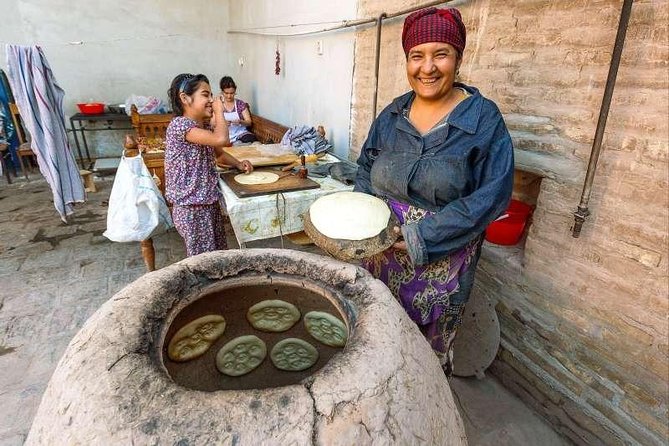
The most appealing part of this Khiva experience is simple: you make the bread yourself, then eat the result. You shape it, add flower ornaments, and help hang it in the bread maker. It is a welcome change from looking at tiled buildings all day.
I like the short 45-minute format and the fact that your own group takes part privately. Tea, baking equipment, and the bread you make are included. The main concern is value: at $15, you are paying for a brief hands-on activity, and the instruction may feel thin if you want a full lesson on Uzbek bread and its history.
Key points for this Khiva bread class
- You prepare and decorate your own bread, including floral patterns.
- You take part in the baking, rather than simply watching a baker work.
- Protective clothing is provided before you work near the high heat.
- Tea and your finished bread are included in the $15 price.
- The class lasts about 45 minutes, making it easy to fit into a day in Khiva.
- Your private group participates alone, with the activity beginning and ending at Tea House Mirza Boshi.
Why bread makes a good break from Khiva sightseeing
Khiva can give you a heavy dose of grand gates, blue tile, minarets, and old walls. That architecture is the reason to come, but after several hours of walking through the old city, a practical activity can wake up your senses again.
This class gives you something to do with your hands. You are not only looking at Uzbek culture through monuments. You are handling dough, shaping decoration, and taking part in a food tradition that ends with something you can eat.
I especially like the connection between the activity and the setting. The class takes place at Tea House Mirza Boshi, where bread is part of a working food environment. One particularly useful detail is that some of the bread participants help prepare may later be served to customers at the restaurant. That gives the session a little more purpose than making a decorative object that disappears into a box.
Still, keep your expectations in proportion. This is a short class, not a cooking school course. The experience gives you a taste of the process, but the supplied details do not promise a long cultural talk, a recipe booklet, or a detailed lesson in regional bread styles.
More uzbek plov cooking classes in Khiva:
- Traditional Khiva Cooking Class with Market Visit & Lunch
★ 5.0 · 4 reviews - Samarkand: Village Tour with Plov Cooking Class & Home Visit
★ 5.0 · 29 reviews - Samarkand: Uzbek Cooking Class in a Village Home
★ 5.0 · 22 reviews
Arriving at Tea House Mirza Boshi
You begin and finish at Tea House Mirza Boshi in Khiva, in the Khorezm Region of Uzbekistan. Since the class is private, only your own group participates. That makes the format more personal than a large demonstration and gives your group the chance to work at its own pace within the short session.
The mobile ticket is useful for a day of sightseeing. You can keep the booking on your phone rather than carrying a printed voucher. Confirmation is provided when you book, so you should have the meeting details ready before setting out.
The location matters because this is not described as a separate countryside bakery visit or a transport-based excursion. You meet at the tea house, take the class there, and return to the same point. That keeps the logistics simple and avoids spending much of a 45-minute activity in a vehicle.
You should allow a little extra time to locate the tea house, especially if you are moving around Khiva’s old center and relying on your phone. The formal activity lasts about 45 minutes, but the practical time around meeting and getting ready may make the whole stop feel slightly longer.
Shaping the Uzbek bread
The hands-on work is the heart of the experience. You prepare the traditional Uzbek bread with help from the professional team. The class is designed so you do not need to know the process before arriving.
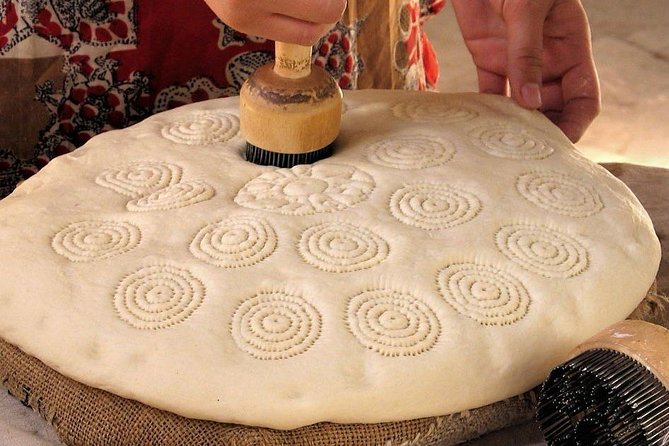
Your part includes shaping the bread and filling in flower ornaments. That decorative step gives the bread its visual character and lets you leave with something that looks distinctly Uzbek rather than like an ordinary round loaf.
The wording of the activity suggests that the staff guide you through the steps and help you produce a good result. That support is important in a short class. You are not expected to figure out dough preparation, decoration, and baking on your own.
I would treat this as a shared practical lesson rather than a technical baking course. You should expect assistance while you work, but not necessarily a detailed breakdown of measurements, fermentation times, or the differences between bread made in different parts of Uzbekistan. Those points are not specified.
The flower designs are likely to be the most memorable part for many people. They give children and adults a clear task, and they make the activity more than a quick demonstration. If you enjoy craft-like details, this should be the part that holds your attention.
Working near the high heat
Before you work around the baking area, you wear protective clothing. The supplied information calls these clothes tankers, with the purpose of helping you handle the high temperature. The important point for you is that protective wear is part of the activity, rather than something you must bring yourself.
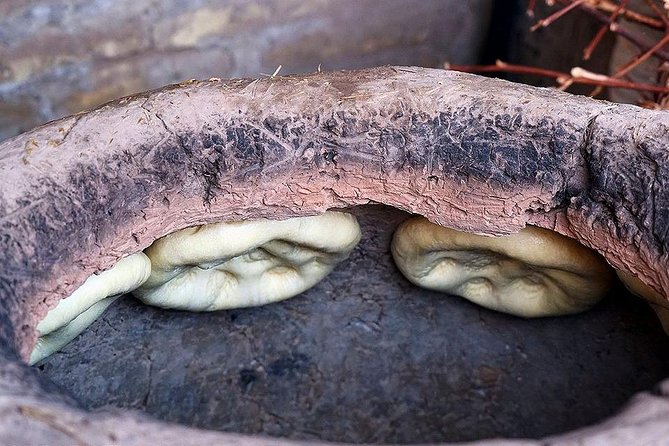
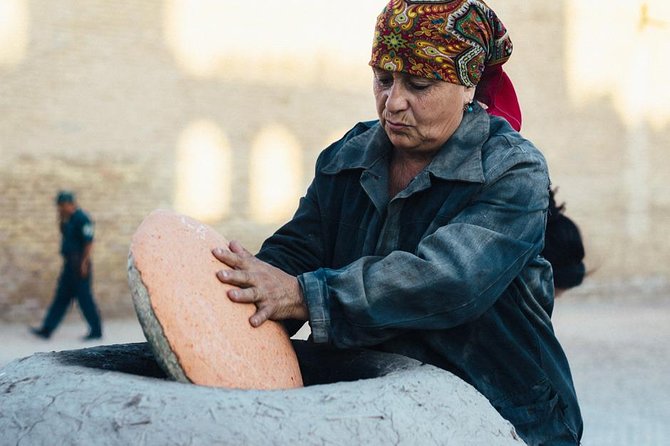
You then help hang the bread in the bread maker. This is the moment when the class shifts from preparation to baking. You have already shaped and decorated the bread, and now you see how it enters the hot cooking space.
The experience does not promise that you will manage every stage alone. The team helps you through the process, which is sensible when high heat is involved. Follow the staff’s directions closely and expect the professionals to control the parts that require the most care.
Because the session is short, the baking stage is likely to be a quick but memorable part of the class. The supplied details do not state how long the bread remains in the oven or whether every participant handles every loaf. You should expect to take part, but not assume that you will personally control the full baking cycle from start to finish.
A few more Khiva trips to weigh up
- Cooking class in Samarkand with local life experience
★ 5.0 · 19 reviews - Private Samarkand Cooking Class with Market Tour & Transfers
★ 5.0 · 14 reviews - Cooking Class in the Village with Local Family in Samarkand
★ 5.0 · 11 reviews - Plov and Samsa Cooking Class in Tashkent
★ 4.3 · 6 reviews
Tea and eating what you made
Tea is included, along with the bread you prepare. That gives the class a clear finish: you make something, wait for it to bake, and then eat it yourself.
This is where the $15 price becomes easier to judge. You are not paying only for flour and oven time. You are also paying for staff help, use of the baking equipment, protective clothing, the private format, and a short cultural activity in a central Khiva setting.
At the same time, $15 is not a bargain if you want a long lesson. One rating described the experience as extremely overpriced because it did not include enough explanation about the bread or its history. That criticism is worth taking seriously. A short class can be fun and still feel expensive if the teaching is limited.
I would book it for the participation, not for the meal alone. If you see the experience as an inexpensive lunch supplement, you may be disappointed. If you see it as a compact chance to make a local staple with your own hands, the cost makes more sense.
What the class teaches, and what it may not
The strongest version of this activity combines demonstration, practice, and a little background. You learn how to prepare the bread, watch the staff manage the hot baking process, and hear enough explanation to understand why the bread matters.
The supplied information confirms the practical part, but it does not promise a long history talk. That gap explains the mixed rating of 3.5 from four ratings. Two ratings gave the activity five stars, praising it as fun, informative, and a good hands-on break from Khiva’s repeated sightseeing pattern. Another gave it two stars because the explanation felt inadequate for the price.
You should therefore ask yourself what kind of learning you want. If you want to stamp your own bread, decorate it, help bake it, and eat it with tea, the class offers those elements. If you want a deep lesson about Uzbek food culture, bread rituals, recipes, or regional differences, the description does not guarantee that level of detail.
A useful approach is to ask questions during the class. You can ask what the ornaments mean, how the bread is normally served, and what makes Uzbek bread different from bread you know at home. The staff may be able to add context, but the activity details do not promise specific answers or a named guide.
How the 45-minute schedule feels
Forty-five minutes is both a strength and a limit. It is long enough for a clear sequence of preparation, decoration, baking, and eating. It is short enough to fit between visits to Khiva’s monuments, a meal, or a rest at your accommodation.
The pace may feel brisk if your group is large, though the private format helps. Since only your group takes part, you do not have to share the session with unrelated participants. That should make it easier to ask questions and keep the activity focused on your party.
The short duration also means the class does not take over your day. I like this for Khiva, where you may want to reserve most of your time for the old city and its major sights. The bread class works best as a small cultural pause, not as the main event of your Uzbekistan trip.
If your group includes young children, the hands-on parts may be easier to enjoy than a long museum visit. The high heat still means you should pay attention to the staff’s instructions, particularly when the bread is being placed in the baking area.
Who will get the most from this activity
This class suits you if you:
- Want a short food experience in Khiva
- Prefer making something to watching a demonstration
- Enjoy decorative work such as shaping flower patterns
- Are looking for a private activity for your own group
- Want to break up a day of monuments and walking
- Like the idea of eating something you helped prepare
It is also a good fit if you have limited time in Khiva. The fixed meeting point and return to the same tea house make the plan easy to fit around other stops.
You may want to skip it if you are mainly seeking a detailed culinary lecture. The current information does not promise extensive background on Uzbek bread, and one rating specifically found the lack of explanation disappointing. You may also want to pass if $15 feels high for a 45-minute activity centered on one loaf of bread.
Price, private format, and cancellation
The price is $15 per person. Included are tea, the use of baking equipment, and the bread you make. Other personal expenses are not included, so you should not assume that additional food, drinks, or purchases at the tea house are covered.
The private format adds value for couples, families, or a small group of friends. You get the activity to yourselves rather than joining a mixed group. The data does not state the maximum group size, so you should not assume that a very large party will receive the same amount of individual help.
Free cancellation is available if you cancel at least 24 hours before the start time. Cancellation within 24 hours is not refundable, and changes within that period are not accepted. The cut-off follows local time in Khiva, so check the start time carefully if you are arranging several activities on the same day.
The experience is booked, on average, nine days in advance. That figure suggests you should not leave it until the last moment if the class fits an important part of your schedule, though availability can change.
My call: book it for the hands-on moment
I would book this class if I wanted a compact, private cultural activity that added food and craft to a day of Khiva sightseeing. The chance to decorate bread, help place it in the hot baking area, drink tea, and eat the finished product gives the session a clear and satisfying shape.
I would not book it expecting a full seminar on Uzbek bread. The mixed score reflects a real choice: some people find the class short, informative, and fun, while others find $15 too much when the historical explanation is limited.
The best way to make the decision is to value the experience rather than the loaf. If you want an active memory from Khiva, and you like the idea of making your own bread in a tea-house setting, this is a sensible pick. If you only want inexpensive food, buy bread elsewhere and save the money.
FAQ
Where does the Uzbek bread class begin?
The class begins at Tea House Mirza Boshi in Khiva, in Uzbekistan’s Khorezm Region.
Where does the activity end?
The activity ends back at the same meeting point, Tea House Mirza Boshi.
How long does the experience last?
The class lasts approximately 45 minutes.
How much does the class cost?
The price is $15 per person.
What is included in the price?
Tea, use of the baking equipment, and the bread you make are included.
Is the class private?
Yes. Only your own group participates in this private activity.
Can I cancel for a full refund?
Yes, if you cancel at least 24 hours before the experience starts. Cancellations or changes made less than 24 hours before the start time are not refundable.
Just added around Khiva
- Traditional Khiva Cooking Class with Market Visit & Lunch★ 5.0 · 4 reviews
- Old Khiva Stories with Your Local Guide★ 5.0 · 5 reviews
- A Night In The Kyzylkum Desert [2] From Khiva★ 4.5 · 3 reviews
- Aral Sea – Extended trip (3 days)★ 5.0 · 5 reviews
- Khorezm Fortress and KyzylKum Desert Private Tour★ 5.0 · 3 reviews
- Best of Khiva: Exclusive Private Tour!★ 5.0 · 3 reviews
- Uzbekistan 6 Days Private Tour Khiva-Bukhara-Samarkand by Train★ 5.0 · 4 reviews
- Ayaz Kala & Toprak Kala private fortress daytrip from Khiva★ 3.5 · 6 reviews
Uzbek Plov Cooking Classes, compared.
Village Tour with Plov Cooking Class & Home Visit
Read our review →
Cooking class in Samarkand with local life experience
Read our review →
Private Samarkand Cooking Class with Market Tour & Transfers
Read our review →
Cooking Class in the Village with Local Family in Samarkand
Read our review →
Samarkand Local Family Cooking Class and Siyob Bazaar Tour
Read our review →Browse the lists this tour appears in