
Reviewed · KHIVA TOURS
Best of Khiva: Exclusive Private Tour!
Khiva’s old town is best understood on foot, and this private walking tour of Itchan Kala gives you a clear route through its blue-tiled monuments, old gates, palaces, and mosques. You move from the Kunya-Ark citadel to Toshhovli Palace, then into quieter religious sites and the lanes of the ancient walled city.
I like the included entrance tickets and the chance to have a historian explain what you are seeing, rather than simply snapping photos of handsome facades. I also like the private format, which lets your group keep its own pace. The main consideration is time: the itinerary contains ten stops, so some visits may feel brisk during the five-to-six-hour schedule.
Key points to know before booking
- A private historian leads the walk: Guides named Nilufer and Nargis are specifically associated with the experience, with a focus on stories, architecture, and local figures.
- The route covers the heart of Itchan Kala: You visit Kunya-Ark, Toshhovli Palace, Juma Mosque, Pahlavan Mahmoud Mausoleum, major madrasas, minarets, and city gates.
- Monument admission is included: You do not need to budget separately for the listed stops.
- The famous tower climb costs extra: Reaching the highest tower requires an additional $15 fee.
- Pickup choices are flexible: Pickup on foot is included, while private transportation is available with the pickup-with-transportation option.
- The price rewards a full sightseeing day: At $76.80 per person, the value is strongest if you want guided context and several paid sights in one organized visit.
Why a guide helps in Khiva’s walled old town
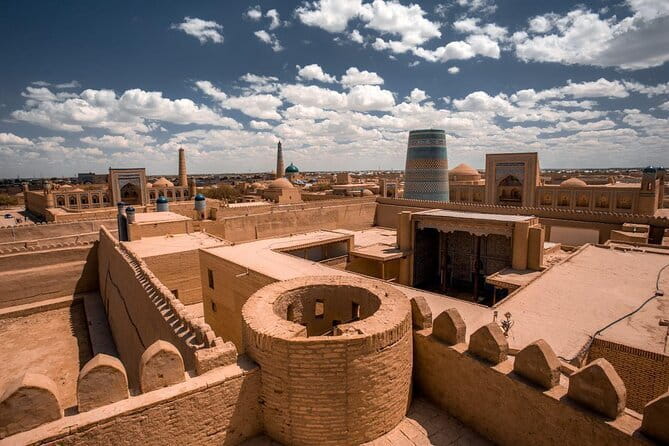
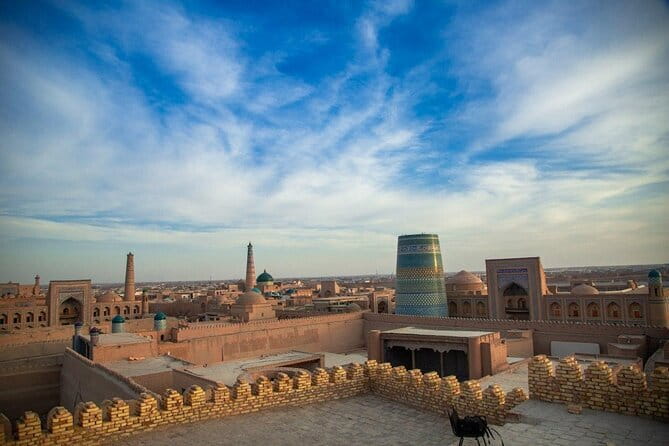
Itchan Kala is compact enough to walk, but its close-packed streets can make independent sightseeing less efficient. A guide gives the route order and connects each building to Khiva’s role as a Silk Road city, so you spend less time working out what deserves your attention next.
The opening stop is the old town itself, a UNESCO-listed fortress city filled with historic streets and Islamic architecture. The ten-minute introduction may sound short, but it sets the scene for the rest of the visit. You are not simply entering a museum complex. You are entering a preserved urban quarter where gates, courtyards, religious schools, palaces, and trading spaces sit close together.
The private format matters here. You can ask about a tile pattern, a ruler, or a building’s former use without waiting for a large group to catch up. The tour is also a practical choice if your time in Khiva is limited and you want the major sights handled in one continuous walk.
A few more Khiva trips to weigh up
- Private Daytrip to 7 Ancient Fortresses of Khorezm
★ 5.0 · 25 reviews - Private Daytrip to Muynak and Nukus
★ 5.0 · 10 reviews - Ayaz Kala & Toprak Kala private fortress daytrip from Khiva
★ 3.5 · 6 reviews
Kunya-Ark, Khiva’s old castle
Kunya-Ark means old castle, and the citadel gives the tour an early dose of royal Khiva. It was built between 1686 and 1688 by Arangakhan, the son of Anushakhan. Its stated dimensions are 130 by 93 meters, and the complex once held an official reception hall along with other functions of the khan’s court.
You have about 40 minutes here, enough for a useful guided look rather than a rushed photo stop. This is one of the places where a historian adds real value. A bare wall or courtyard can be difficult to read on your own, while an explanation of court life and the citadel’s role gives the architecture a purpose.
The site is also a good early reminder that Khiva is more than tilework. The power of the city was organized inside compounds such as this one. Look for changes in scale between public spaces and enclosed areas, and listen for how the guide explains the difference between religious, residential, and political buildings.
Two Mohammed Rahim Khan madrasas
The itinerary includes the Mohammed Rakhim Khan Madrassah and the Mohammed Amin Khan Madrassah. The names can be confusing, especially because both are part of the same concentrated historic quarter, so having a guide is useful.
The Mohammed Rakhim Khan madrasa sits east of Kunya-Ark and is linked to Said Muhammad Rahim Bahadur Khan, known locally as Madraim Khan II. You have around 40 minutes to examine the building and hear its story. Madrasas were religious schools, but their architecture also tells you about scholarship, patronage, and the public image of a ruler.
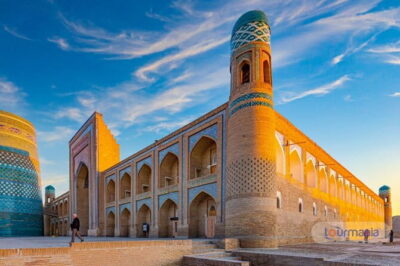
The Mohammed Amin Khan Madrasa receives another 30-minute visit. It is one of Itchan Kala’s major landmarks and pairs naturally with the Kalta Minor Minaret nearby. I would pay attention to the relationship between the broad facade and the minaret rather than treating the two as separate photo subjects.
The tour does not promise long museum-style study at every stop. Instead, it gives you a structured look at the main buildings, with enough explanation to make the route meaningful. If you want to inspect every room or tile panel at length, you may need extra time after the tour.
Kalta Minor, the unfinished blue minaret
Kalta Minor means low tower, an unexpectedly modest name for one of Khiva’s most recognizable sights. The minaret was begun in the 19th century by Mukhammad Amin-khan but was never completed. Its unfinished state is part of its appeal.
The scheduled 30 minutes here should give you time to appreciate the colored tile bands and hear why an incomplete monument became such a strong part of Khiva’s visual identity. This is also a useful place for photographs, with the nearby madrasa helping frame the tower.
A separate charge applies if you want to climb the highest tower, $15 according to the tour details. That fee is not included in the tour price, so decide in advance if the view matters to you. The standard tour still includes the monument visit without requiring the climb.
Same Silk Road, a completely different kind of day:
- Transfer: Bukhara – Khiva via Ancient Fortresses
★ 4.5 · 101 reviews - Daytrip From Khiva To Ancient Fortresses
★ 4.6 · 60 reviews - Khiva Historical City Highlights Guided Walking Tour
★ 5.0 · 30 reviews - Aral Sea Adventures (2 day)
★ 5.0 · 30 reviews
Toshhovli Palace and the khan’s court
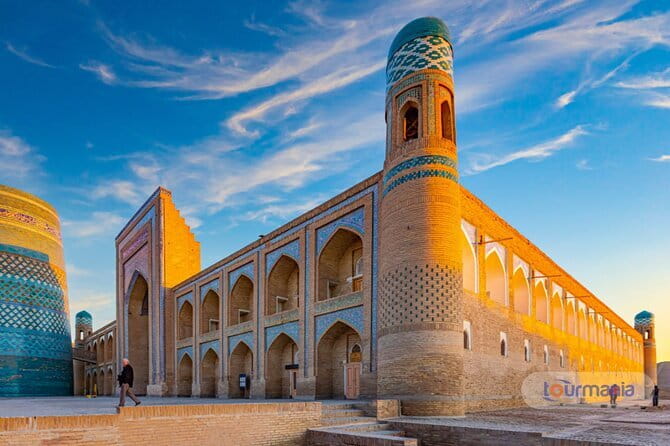
Allow an hour for Toshhovli Palace, the longest scheduled stop. Also written as Tash-Hauli or Tosh-Hauli, this major complex lies inside the old city and gives you a different side of Khiva from the madrasas and mosques.
The palace name refers to a stone courtyard, and the site is best approached as a courtly complex rather than a single room or facade. Your guide can help separate ceremonial spaces from more private areas and explain how the palace fitted into the life of Khiva’s rulers.
This is likely to be one of the most rewarding stops for visitors who want more than a procession of monuments. The hour allows room for architectural details, tilework, courtyards, and questions. It also provides a change of rhythm after the citadel and madrasa visits.
Because Toshhovli receives the largest time allowance, it is a good place to slow down. I would resist the temptation to hurry toward the next famous photograph. The value here lies in seeing how an elite residence worked as a lived compound.
Pahlavan Mahmoud, poet, philosopher, and local hero
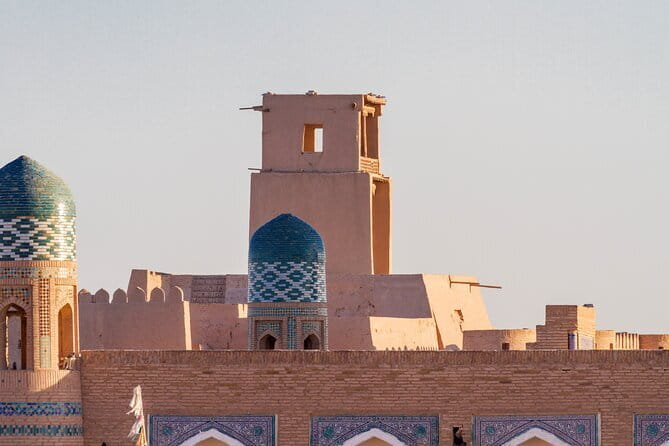
The Pahlavan Mahmoud Mausoleum offers a more personal and spiritual pause. Pahlavan Mahmoud was known as a local poet and philosopher, as well as for heroic strength and the ability to heal people. The complex is near Juma Mosque and was originally connected with his burial place.
You have about 40 minutes here. That is enough time to consider the religious importance of the site and the way a respected local figure can shape a city’s identity. The visit also breaks up the focus on royal buildings and public monuments.
Dress and behavior should be respectful at religious sites, even though the tour information does not specify a formal dress code. Your guide can provide the context you need on site, and the private setting makes it easier to ask questions discreetly.
Juma Mosque and its forest of columns
Juma Mosque sits in the central part of Itchan Kala, close to other major sights. The visit lasts about 40 minutes, giving you time to absorb the mosque’s interior rather than treating it as a quick stop between streets.
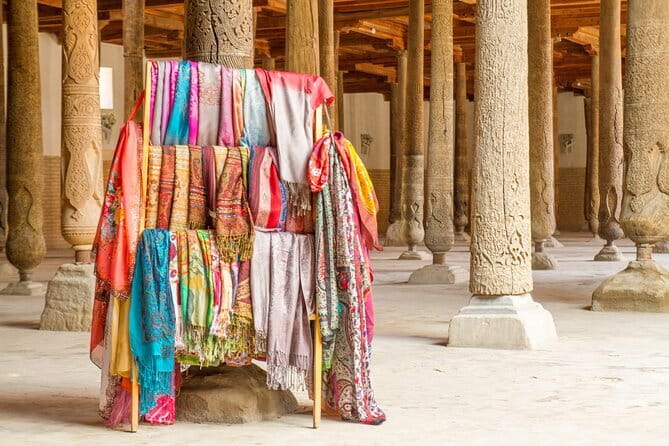
The mosque is particularly valued for its traditional interior arrangement, with many wooden columns supporting the roof. The effect is quieter and more atmospheric than the grand exterior of a palace or madrasa. Here, look up and across the rows of columns, and let the guide point out details that are easy to miss.
This stop also shows why a walking tour works well in Khiva. Juma Mosque is close to the Pahlavan Mahmoud complex and other central monuments, so the route links sites that make geographic sense. You get a better feel for the old town as a functioning city, not just a collection of isolated attractions.
Khiva’s gates, from Polvon Darvoza to Ota Darvoza
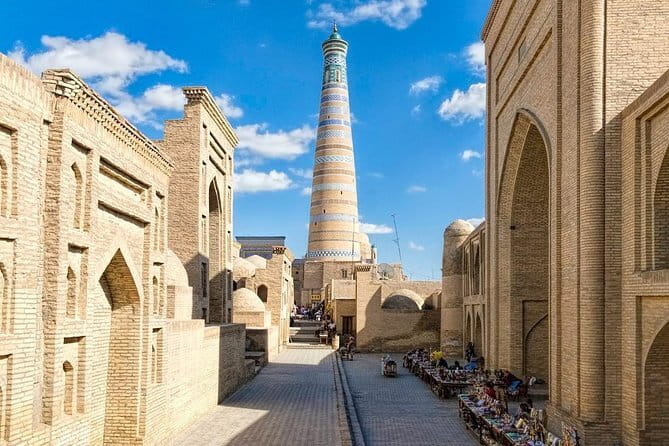
The final part of the route includes Polvon Darvoza and Ota Darvoza, two historic gates of the walled city. Each receives about 30 minutes, which may seem generous for a gate, but these entrances help explain Khiva’s place on old trade routes.
Polvon Darvaza once controlled access to the city and welcomed merchants. Its traditional Uzbek design is worth more than a passing glance, especially when your guide explains how gates regulated movement through the old town.
Ota Darvaza was another main entrance for traders and people arriving along the Silk Road. Seeing both gates lets you compare Khiva’s points of entry and understand how the fortified city connected to the wider desert routes.
These stops are also practical orientation points. After visiting them, you should have a clearer mental map of Itchan Kala. If you plan to return for independent wandering, remember which gate leads toward the streets and buildings you most want to revisit.
A five-to-six-hour schedule with a lot packed in
The listed stop times add up to roughly five hours and 50 minutes. That fits the advertised five-to-six-hour duration, but it leaves little spare time for long pauses, extended photography, or an unplanned lunch.
The tour includes photo stops at the best spots, but lunch is not included. Plan to eat before or after the experience, or ask your guide about timing if your schedule allows a break. Do not assume the tour price covers food.
Pickup is offered in more than one form. Pick-up on foot is included, and private transportation is included if you choose the pickup-with-transportation option. Since the tour is primarily a walking visit inside the old town, check the exact pickup choice when booking so you know how your day begins.
Most people can participate, and the activity is private for your group only. That gives you more control over the pace than a standard group outing, though the packed route still requires several hours on foot.
Is $76.80 a good value?
At $76.80 per person, this is not the cheapest way to stroll through Khiva. The price makes more sense when you count what is bundled into the experience: a private historian, entrance tickets to the listed monuments, all fees and taxes, photo stops, and optional transportation depending on the selection you make.
I see the strongest value for someone visiting Khiva for a short time. The tour covers the city’s major sights in one organized route, and guides such as Nilufer and Nargis are associated with clear explanations and stories that bring the mosques, madrasas, and museums into focus.
A solo visitor may find the cost harder to justify than a couple or small group, since the experience is priced per person. Group discounts are available, so check the current total if you are booking for several people.
The extra $15 tower charge is the only clearly stated monument-related cost beyond the tour. Lunch remains separate. These are small points, but knowing them helps you compare the true cost with an independent day of sightseeing.
The guide makes the difference
The most praised part of this experience is the guiding. Nilufer is specifically noted for her explanations and stories, while Nargis is associated with bringing the mosques, madrasas, and museums to life. The important point is not just that a guide accompanies you. It is that the tour is built around interpretation.
You should expect historical explanation at each major stop, with the chance to move through the city without constantly deciding where to go next. That is especially useful in a place where several monuments sit within a short walk but have very different functions and stories.
Because this is a private activity, you can ask for clarification and keep the focus on your interests. If you care most about Islamic architecture, local rulers, religious figures, or Silk Road trade, say so early. The guide can then shape the emphasis within the fixed route.
Who should book this Khiva tour?
I would choose this tour if you have one main day in Khiva, want the major monuments covered, or prefer historical context to independent sign-reading. It also suits couples, families, and small groups who value a private pace and included admissions.
It is less suitable if you want a loose, unplanned wander with long cafe breaks. The schedule is full, lunch is not included, and the tour spends time at ten separate locations.
The experience is also a good fit if you are concerned about missing key sights. The route includes the principal landmarks of Itchan Kala, from Kunya-Ark and Kalta Minor to Toshhovli Palace, Juma Mosque, Pahlavan Mahmoud Mausoleum, and the old gates.
You receive confirmation when booking, and free cancellation is available up to 24 hours before the local start time. Cancellations or changes inside that 24-hour window are not refunded or accepted.
Should you book it?
Book this private Khiva tour if you want an efficient, story-led introduction to Itchan Kala with monument tickets already handled. The combination of a historian, a private group, and a long list of major sites gives you strong value when your time is short.
Skip it if your priority is complete independence or a slow day with no fixed route. For most first visits, though, the structured walk is a sensible way to get your bearings and understand why Khiva’s old town deserves more than a quick photo stop.
FAQ
Where does the tour take place?
The experience takes place in Khiva, Uzbekistan, mainly inside Itchan Kala, the UNESCO-listed walled old town.
How long does the tour last?
The tour lasts approximately five to six hours.
Is the tour private?
Yes. Only your group participates in this private activity.
Are entrance tickets included?
Yes. Entrance tickets to the monuments on the tour are included.
Is transportation included?
Private transportation is included with the Pick-Up with Transportation option. Pick-up on foot is also included.
Is lunch included?
No. Lunch is not included in the tour price.
Does the tour include the highest tower climb?
No. Climbing the highest tower costs an additional $15.
Can most people participate?
Yes. The tour information states that most people can participate.
What is the cancellation policy?
You can cancel for a full refund up to 24 hours before the experience start time. Cancellations or changes made less than 24 hours before the start are not accepted or refunded.
Just added around Khiva
- Traditional Khiva Cooking Class with Market Visit & Lunch★ 5.0 · 4 reviews
- Old Khiva Stories with Your Local Guide★ 5.0 · 5 reviews
- A Night In The Kyzylkum Desert [2] From Khiva★ 4.5 · 3 reviews
- Master Class – Uzbek Bread (Khiva)★ 3.5 · 4 reviews
- Aral Sea – Extended trip (3 days)★ 5.0 · 5 reviews
- Khorezm Fortress and KyzylKum Desert Private Tour★ 5.0 · 3 reviews
- Best of Khiva: Exclusive Private Tour!★ 5.0 · 3 reviews
- Uzbekistan 6 Days Private Tour Khiva-Bukhara-Samarkand by Train★ 5.0 · 4 reviews
Khiva Tours, compared.
Khiva Historical City Highlights Guided Walking Tour
Read our review →
Daytrip From Khiva to Aral Sea Cemetery Of Ships . All In One
Read our review →Browse the lists this tour appears in