
Reviewed · 2-DAY EXPERIENCES
Fergana Valley 2-Day Private Tour
The best part of this tour is its focus on ordinary life and working traditions rather than only grand Silk Road monuments. In two days, you move from Kokand’s tiled palace and mosque to Rishtan pottery studios, Kuva’s old ruins, and Margilan’s silk workshops.
I like the private format, which keeps the pace flexible for a small group of up to three people. I also like the way the route links several distinct parts of the valley, especially the chance to see ceramics and natural silk being made instead of only buying finished souvenirs.
The main consideration is time. The sightseeing totals only about six hours across two days, with the rest used for transport, and admission tickets, meals, and accommodation cost extra. You should also be comfortable with a one-way route from Kokand to Margilan.
Key points to know before booking
- Kokand opens the tour with grand architecture: The Khan Palace and Jami Mosque give you the strongest dose of decorative art and historic city life.
- Rishtan is the hands-on craft stop: You visit the Fergana Valley’s best-known pottery center and see the local ceramic tradition at close range.
- Margilan brings the most distinctive workshop experience: Natural dyes and silk production provide the tour’s clearest look at living craft.
- Kuva adds an archaeological pause: The hilltop ruins show the remains of an old Silk Road settlement, but this is a ruin site rather than a restored monument.
- The private group size is useful: Up to three people can travel together with private transport and a local guide.
- The route ends at Margilan train station: This can work well if you plan to continue by rail, but you need to arrange your own onward plan.
Why the Fergana Valley deserves two days
Samarkand and Bukhara get most of the attention in Uzbekistan. That makes sense, since their monuments are extraordinary. But the Fergana Valley gives you a different kind of trip, one based more on local production, regional identity, and daily work.
Here, the memorable sights are not limited to domes and grand squares. You see a palace covered in mosaic and majolica, a mosque supported by 98 columns, pottery made for pilaf and tea, ancient city ruins, and silk dyed in natural colors. The route connects architecture with the work that has shaped life in the valley for centuries.
This is a good choice if you want more than a checklist of famous buildings. I would not book it as a replacement for Samarkand or Bukhara. I would choose it as a companion to those cities, especially if you want to understand how craft, farming, food, clothing, and household goods fit into the wider story of Uzbekistan.
The tour costs $250 per group of up to three people. For three people, that is about $83 per person for two days of private transport and a local guide. For one person, the price is less of a bargain, since the full group rate still applies. The value improves if you share it with two companions and make good use of the private format.
A few more Uzbekistan trips to weigh up
- 2 Days Tour to Bukhara and Samarkand from Tashkent by train
★ 5.0 · 53 reviews - Fergana – Golden Valley From Tashkent 1 night / 2 days
★ 4.5 · 41 reviews - Yurt stay and Hiking in the Nurata Mountains tour – 2 days
★ 5.0 · 35 reviews
Kokand’s Khan Palace and a courtyard of color
Your first major stop is Kokand’s Khan Palace, visited for about an hour. You walk through a park before reaching the palace, which makes the arrival feel gradual rather than abrupt. The building is known for its mosaic and majolica decoration, with surfaces covered in many shades and intricate patterns.
This is the sort of place where you should slow down and look closely. The appeal is not just the overall shape of the palace. It is the work of the craftsmen in the tile, the color changes, and the decorative details that reveal how much care went into the building.
The stop is short enough to keep the day moving, but you may want more time if you enjoy architecture and photography. An admission ticket is not included, so budget separately for entry. The tour provides transport and guiding, but you should not assume that every site fee is covered by the $250 price.
Kokand gives the first day a formal opening. After this palace, the tour shifts from courtly architecture to religious architecture and then to working craft.
Jami Mosque and its 98 columns
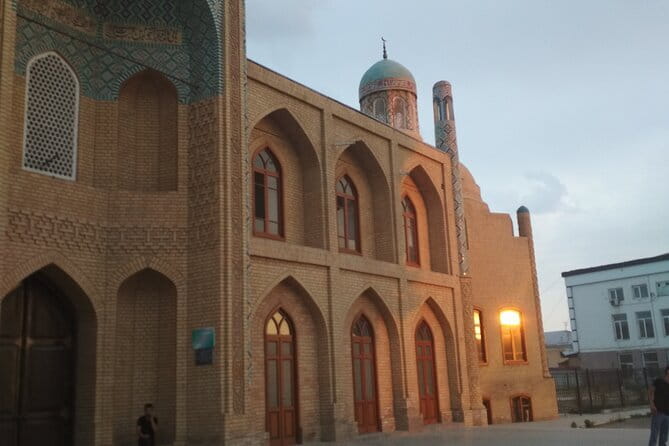
The Jami Mosque sits in the center of Kokand and was built in the 19th century. You have about 50 minutes here, enough to appreciate the main structure and the unusual column arrangement without turning the visit into a long architectural study.
The mosque’s most specific feature is its 98 sharply defined columns, described as the work of local craftsmen. That detail helps you read the building in a more useful way. Instead of seeing only a large prayer space, you can pay attention to the repeated forms, the scale of the supports, and the practical skill needed to create such an interior.
This is also a place where respectful dress and behavior matter. The supplied details do not specify current opening hours or entry rules, so your guide is the right person to consult on the day. Admission is not included, and the visit may be affected by local access conditions.
The palace and mosque work well together. The palace shows decorative power and royal taste. The mosque gives you a sense of civic and religious architecture in the same city.
Rishtan pottery, from pilaf plates to tea cups
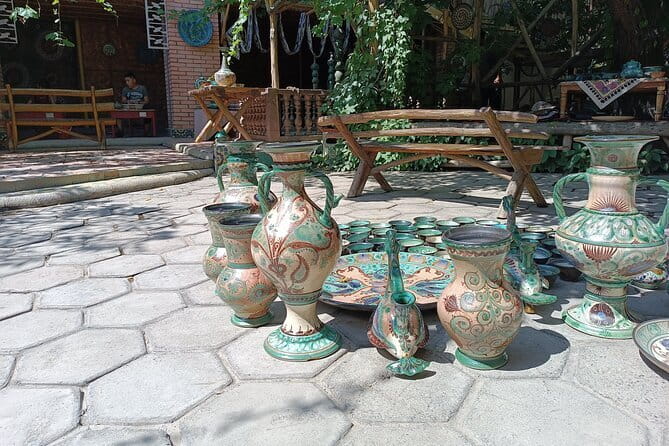
Rishtan is the most practical craft stop on the first day. The town has been associated with pottery for more than 900 years, and the local workshops still make objects intended for everyday use.
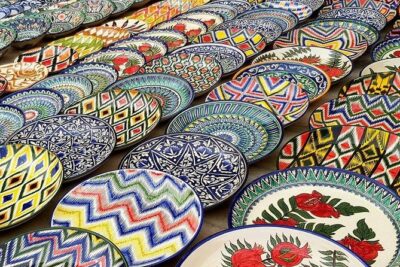
You may see bright blue ceramics made as lyagans, large dishes used for pilaf, along with bowls, tea cups, and kuza jugs. These are not simply display pieces. Their forms connect directly to cooking, serving, and drinking in Uzbek homes.
The visit lasts about an hour and admission is free. That makes it one of the better-value stops on the route, especially if you are interested in handmade goods. You can look at the process, ask questions through your guide, and decide for yourself if a piece is worth buying. The information provided does not promise a particular workshop or a guaranteed demonstration, so think of this as a visit to Rishtan’s pottery tradition rather than a fixed production show.
I especially like this stop because it gives the tour a physical, useful focus. You are not just learning that the valley has a ceramic tradition. You are seeing the kinds of objects that carry that tradition into daily life.
Same Silk Road, a completely different kind of day:
- Best of Tashkent Mountains: Amirsoy, Chimgan & Charvak Trip
★ 4.8 · 567 reviews - Samarkand: Historical Monuments Guided Walking Tour
★ 4.8 · 446 reviews - Samarkand One Day Tour – Departure From Tashkent
★ 5.0 · 313 reviews - Private Samarkand City Tour With Transportation
★ 5.0 · 149 reviews
Fergana city and the memory of Ahmad al-Fergani
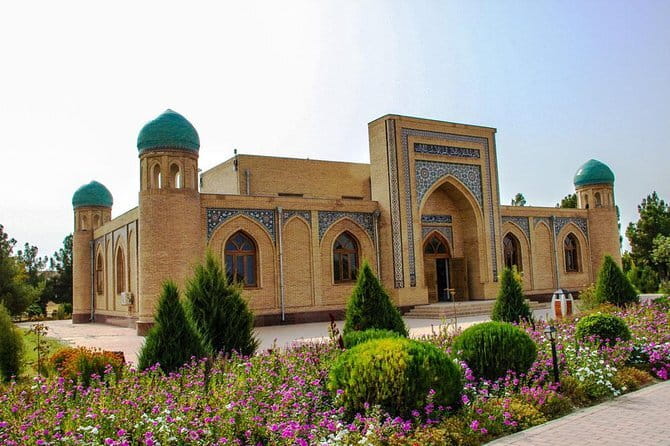
Day two begins in Fergana, with about 50 minutes for sightseeing. A monument to Ahmad al-Fergani, the 9th-century astronomer and mathematician, occupies a prominent place in the square. He is presented as a major local figure and a source of pride for the city.
This stop adds intellectual history to a route otherwise shaped by palaces, ruins, and workshops. It is a useful reminder that the Fergana Valley was connected to scientific and cultural work as well as trade and manufacturing.
You also see examples of Russian-period colonial architecture in the area. The details provided do not specify individual buildings, so you should expect a general look at the city’s older architectural character rather than a long guided tour of named sites.
Fergana is a relatively brief stop. I would treat it as a city orientation and a chance to see the main square, not as a full city visit. The free admission keeps the cost down, but the short timing means you will need to focus on what interests you most.
Kuva’s hilltop ruins and a harder kind of history
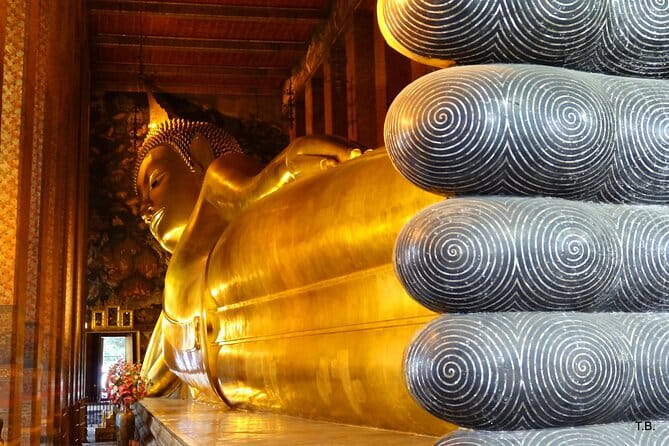
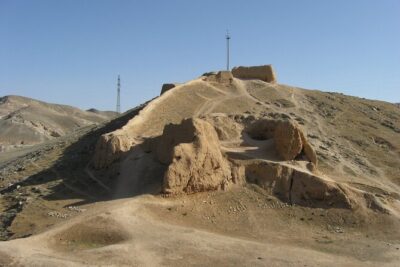
Kuva takes about 40 minutes and offers the route’s clearest archaeological stop. In the older part of the city, a hill holds the remains of a former citadel and shakhristan, the central part of an ancient settlement.
The ruins and excavations point to Kuva’s importance on the old Silk Road. The settlement did not survive the Mongol invasion, and the remaining walls show the limits of what time and conflict leave behind.
Do not expect a polished monument complex here. This is valuable precisely because it is less restored and less complete. You are looking at traces of a former city, not a grand building that still presents its original appearance. That can make the visit feel quieter and more open to interpretation, but it may be less satisfying if you want elaborate decoration or a large museum collection.
The visit is free. Since only 40 minutes are allocated, listen closely to the guide’s explanation and use the time to get a clear sense of the site’s layout. The stop works best when you view it as a short historical pause between the city visit in Fergana and the craft-focused finale in Margilan.
Margilan and the making of natural silk
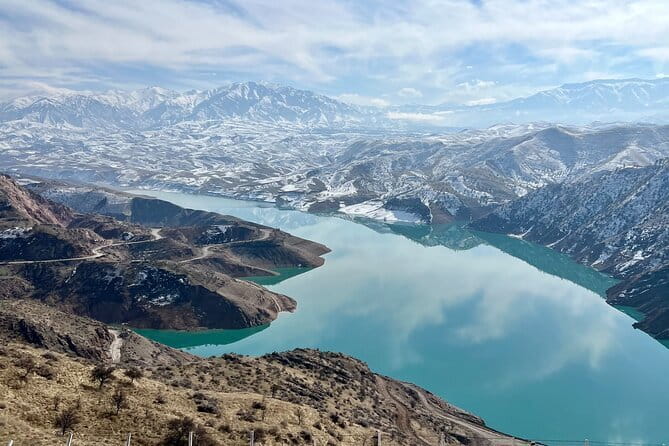
Margilan is the strongest finish for the tour. You spend about two hours learning about the city’s silk production, including the use of natural dyes and the continuation of traditional handcraft.
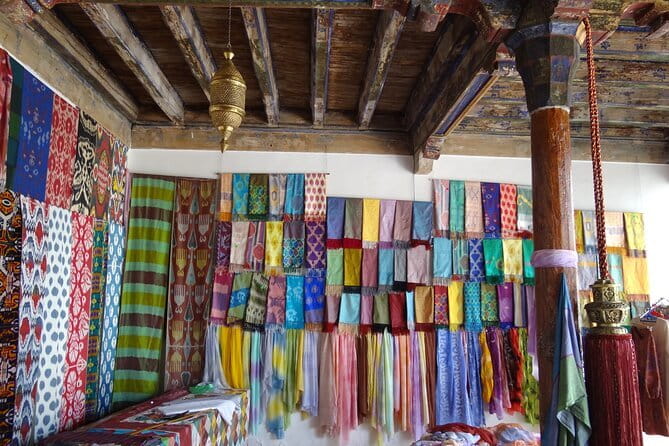
The dyeing process is the main attraction. Fabric is colored in a wide range of shades using natural materials, creating patterns and tones that cannot be reduced to a single souvenir-shop display. Watching this work gives you a better sense of the time and skill behind a silk textile.
Margilan is known as a center of natural silk production, and the stop gives you a direct look at a tradition still tied to local work. I would allow yourself time to compare fabrics carefully rather than rushing to the first item you see. The tour information does not state that purchases are required or included, so buying something is your choice and should be treated as an extra expense.
The two-hour visit is the longest single stop. That is sensible. Silk production needs more time than a quick photo stop, and you will have a better chance to understand the sequence of dyeing and handcraft. The supplied details do not promise a specific factory, named artisan, or exact demonstration, so the experience may depend on the workshop available that day.
Private transport and the shape of the two days
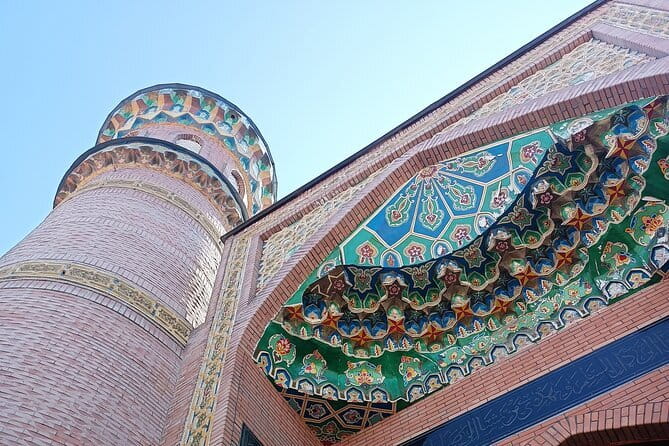
This is a private tour for your group alone, with a maximum of three people. That is its clearest practical advantage. You do not have to match the pace of a large bus group, and you can ask the local guide to explain details that matter to you.
The start point is listed at AvgoMoyka Tango in Kokand. The end point is at Uzun Xovuz in Margilan, with the meeting information also identifying the Margilan train station. Because the route begins in one city and ends in another, this is not a simple round trip. Check your accommodation and onward transport before booking.
The sightseeing time adds up to roughly six hours:
- Khan Palace: about one hour
- Jami Mosque: about 50 minutes
- Rishtan: about one hour
- Fergana: about 50 minutes
- Kuva: about 40 minutes
- Margilan: about two hours
The stated two-day duration includes transport, so the driving portions are important. You should not read the stop times as a full two-day schedule of continuous sightseeing. This format suits you if you want to cover several parts of the valley without arranging each transfer yourself.
Food, accommodation, and entrance tickets are not included. That gives you control over spending, but it also means you need to plan the overnight arrangements and meals separately. Confirmation is normally provided when you book, though a booking made within two hours of departure is confirmed as soon as possible and depends on availability.
Service animals are allowed, and the experience is near public transport. Most people can participate, but the supplied information does not provide detailed accessibility notes for every site.
How the guide affects the experience
The provider is Sardorbek, and the tour includes a local guide and private transport. No individual guide name is provided, so you should not book expecting a particular named person.
The strongest praise attached to this experience focuses on the guide and the ability to cover many places while meeting local craftspeople and seeing manufacturing work. That is exactly where the tour’s success will matter most. The buildings are worthwhile, but good explanations can connect them to the valley’s customs, materials, and working life.
Before setting out, I would ask the guide how much time is available at each workshop, which entrance fees apply, and how the overnight transfer is organized. Those questions do not change the route, but they help you use the private format well.
Who will get the most from this tour?
I would recommend this experience to you if you:
- Want to add the Fergana Valley to a wider Uzbekistan trip
- Prefer local crafts and production to a schedule made only of famous monuments
- Are traveling with one or two companions
- Like private transport and a route that ends in a different city
- Want to see pottery and silk traditions in the places associated with them
- Can handle a compact schedule with substantial transport time
I would be more cautious if you want long visits at each attraction, extensive museum time, or a fully inclusive package. The tour does not cover meals, accommodation, or tickets, and the sightseeing periods are fixed and fairly short.
Should you book the Fergana Valley tour?
Book it if you want a practical introduction to several sides of the valley in two days. The best reasons are the small private group, the strong focus on local crafts, and the contrast between Kokand’s decorated monuments, Kuva’s archaeological remains, and Margilan’s silk work.
The price is most attractive when split among three people. Make sure you are comfortable arranging accommodation and meals, and confirm your transport plans for the Margilan finish. If those details suit your trip, this is a useful way to see the Fergana Valley beyond its headline cities.
FAQ
How much does the private Fergana Valley tour cost?
The tour costs $250 per group of up to three people. The price includes a local guide and transport.
What is not included in the tour price?
Food, entrance tickets, and accommodation are not included. You need to budget for these separately.
Where does the tour start and finish?
The tour starts at AvgoMoyka Tango in Kokand. It finishes in Margilan at the Uzun Xovuz area, with the meeting information also identifying the Margilan train station.
How much sightseeing time is included?
The listed sightseeing time is about six hours across the two days. The rest of the approximately two-day duration is used for transportation.
Is this a group tour?
No. This is a private activity for your own group, with up to three people participating.
Can I cancel for a full refund?
Yes, if you cancel at least three full days before the experience start time. Cancellations made within three days are not refunded, and changes made within that period are not accepted.
Just added around Uzbekistan
- Traditional Khiva Cooking Class with Market Visit & Lunch★ 5.0 · 4 reviews
- Private Intercity Transfer Tashkent – Samarkand – Tashkent★ 3.5 · 3 reviews
- Tashkent Mountain Tour Amirsoy with Transport★ 3.5 · 3 reviews
- Tashkent-Samarkand-Bukhara tour-3nights/4 days★ 5.0 · 5 reviews
- Amirsoy & Chimgan mountain tour from Tashkent★ 5.0 · 3 reviews
- Private Tashkent City Tour★ 5.0 · 3 reviews
- Tashkent Food and Metro Journey★ 5.0 · 4 reviews
- Silk Road Secrets Tour in Uzbekistan★ 5.0 · 4 reviews
2-Day Experiences, compared.
2 Days Tour to Bukhara and Samarkand from Tashkent by train
Read our review →
Yurt stay and Hiking in the Nurata Mountains tour – 2 days
Read our review →
Browse the lists this tour appears in