
Reviewed · TRAIN EXPERIENCES
Uzbekistan 3 Day Private Tour Tashkent-Bukhara-Samarkand Bullet Train
The best thing about this three-day Uzbekistan tour is its smart use of the Afrosiyob bullet train. You cover three major Silk Road cities without losing whole days to road travel, while private drivers and city guides handle the ground work. I especially like the included monument tickets and the two central hotel nights, since those costs can quickly add up in Uzbekistan.
I also like the private format. You tour with only your own party, and guides such as Muhlio, Malika, Max, Beck, and Dilshod have earned strong praise for clear English and lively explanations. The main caution is the pace: Bukhara begins on arrival day, and summer heat can make the afternoon walking tour tiring.
Key points to know before booking
- Three cities in three days: Tashkent, Bukhara, and Samarkand fit into a tight schedule built around fast trains.
- Bullet train tickets are included: The route is Tashkent to Bukhara, Bukhara to Samarkand, then Samarkand back to Tashkent, subject to availability.
- Private guiding in each city: You get a guide for your own group rather than joining a large coach tour.
- Bukhara is explored on arrival day: Expect an afternoon of mosques, the Ark, trading domes, and Lyab-i-Hauz.
- Two hotel nights and two breakfasts are included: Lodging is described as central, three- to four-star, or boutique, but not luxury.
- The price is $500 per person: That covers transport, guides, tickets, hotels, and taxes, with a $40 single-room supplement.
Why the bullet train makes this route work
Uzbekistan is large enough that city-hopping can eat up your holiday. Here, the fast train does the hard work. The first journey from Tashkent to Bukhara takes about four hours, the Bukhara to Samarkand run takes about two hours, and the final Samarkand to Tashkent trip also takes about two hours.
That is a much better use of your time than building the trip around long private road transfers. The trains also give the route a clear rhythm: ride in the morning, settle into the next city, then explore with a local guide.
The important qualification is subject to availability. Train tickets are included, but the operator confirms the booking within 48 hours and depends on seats being available. If you are traveling in a busy season, book well ahead. The average booking time is about 43 days before departure, which gives you a useful sense of how far ahead many people arrange this trip.
Your start point is Tashkent North Railway Station, called Toshkent Railway Station Shimoliy, at 7:30 a.m. Pickup can be requested if it is easier, but the stated included transfer does not cover the first morning trip to the station or the final evening transfer from the station to your hotel or airport. Check this point carefully before you arrive.
A few more Tashkent trips to weigh up
- 2 Days Tour to Bukhara and Samarkand from Tashkent by train
★ 5.0 · 53 reviews - Tashkent Airport & Train Station Pick Up & Drop Off
★ 4.5 · 50 reviews - Day Tour to Samarkand from Tashkent by train.
★ 5.0 · 34 reviews
Day one: from Tashkent to Bukhara’s old center
The first morning starts early. You take the train from Tashkent to Bukhara, a journey of about four hours. Once you arrive, a driver meets you at Bukhara Railway Station and takes you to your hotel for check-in before you meet your Bukhara guide.
This transition is efficient, but it leaves little room for delay. You have a full sightseeing program ahead, so keep your morning organized and do not assume you will have time to linger around the station.
Poi Kalyan Mosque and the Kalyan Minaret
Your first major stop is the Poi Kalyan complex. The Kalyan Minaret rises 45.6 meters and dates to 1127, making it one of the oldest surviving pieces of the Kara-Khanid-era mosque complex. It survived the Mongol conquest, which helps explain why this single tower carries so much weight in Bukhara’s story.
Allow about an hour here. Your guide can help connect the architecture to the city’s place on the old Silk Road, rather than leaving you to see the minaret as just a tall brick tower. The complex is one of the strongest early impressions of Bukhara.
The Ark of Bukhara
The Ark is a fortified royal compound, effectively a town within the city. It served as the home of Bukhara’s rulers for more than a thousand years, and the site remains one of the city’s essential stops.
You spend about an hour here. The Ark works best with a guide because its importance is not only visual. It represents the long political life of Bukhara, where rulers, officials, soldiers, and court life operated inside a fortified center.
Same Silk Road, a completely different kind of day:
- Best of Tashkent Mountains: Amirsoy, Chimgan & Charvak Trip
★ 4.8 · 567 reviews - Samarkand One Day Tour – Departure From Tashkent
★ 5.0 · 313 reviews - Tashkent City Tour
★ 5.0 · 121 reviews - Amirsoy, Chimgan & Charvak Full-Day Adventure
★ 4.9 · 82 reviews
Bolo Hauz and Maghak-i Attari
Across from the Ark is Bolo Hauz Mosque, known for its carved wooden columns and its position beside an artificial pool. You have about 30 minutes here, enough to take in the relationship between the mosque, the Ark, and the water feature.
Maghak-i Attari Mosque offers a different kind of historical layering. The site is described as Central Asia’s oldest mosque and is linked to earlier Buddhist and Zoroastrian use. Its brickwork is the main attraction, and your half-hour visit gives you time to look closely at the details.
This is one of the tour’s best features: you are not seeing only grand Timurid monuments. You are also being shown places where different religious and cultural periods overlap.
Bukhara’s trading domes
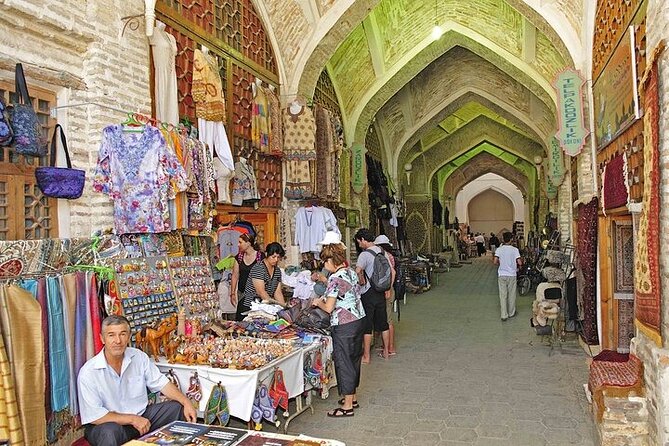
The trading domes preserve the feel of an old covered bazaar. Today, you can browse colorful stalls and see artisans’ workshops, with about an hour set aside for the stop.
This is a good place to slow your pace. The domes are not simply a shopping break. They help you picture Bukhara as a commercial center where merchants and craftspeople worked along the Silk Road. If you want souvenirs, this is one of the natural places to consider them, though the tour does not promise any particular shopping activity or purchases.
Lyab-i-Hauz after the main monuments
The day ends at Lyab-i-Hauz, a square built around a pool and surrounded by historic buildings from the 16th and 17th centuries. You have about two hours here, which is a welcome change after a day of scheduled stops.
This is the part of Bukhara where I would make room for a slower walk and a proper meal if your schedule allows. The pool, old buildings, and public-square setting give you a sense of how the city works beyond its famous monuments.
The weakness is timing. You arrive in Bukhara after a four-hour train ride, then begin a long walking program. In hot weather, the afternoon can be demanding. One review specifically noted temperatures around 100 degrees Fahrenheit and argued for starting Bukhara earlier or moving major sightseeing to after 4 p.m. The operator said it would adjust summer start times, but you should still confirm the schedule before departure.
Day two: free time, optional countryside, and Samarkand
The second morning is lighter. You have free time in Bukhara, or you can request an optional four-hour outing to the Emir’s Summer Palace, the Naqshbandi Mausoleum, and the Samani Mausoleum.
Because this excursion is optional, you should decide what kind of trip you want. If you prefer more architecture in Bukhara, use the morning to revisit the old center at a cooler hour. If you want a broader view of the area, the countryside option adds sites beyond the central walking route.
The train transfer begins in the afternoon. Bukhara Railway Station is in Kagan, about 10 kilometers away, and a driver takes you there. You then ride to Samarkand for roughly two hours before another transfer takes you to your hotel.
This day is less crowded than the first, but it is still not a full sightseeing day in Samarkand. The main Samarkand program comes on day three, so do not expect an extensive evening tour after checking in.
Day three: the grand monuments of Samarkand
Samarkand is the visual high point of the trip. The day covers the Registan, Gur Emir, Shah-i-Zinda, Bibi Khanym Mosque, Siab Bazaar, and Ulugh Beg Observatory before the train back to Tashkent.
That is a lot. Wear comfortable shoes, keep water handy, and expect a substantial amount of time on foot. The private guide format helps because your guide can explain what matters at each stop and adjust the pace where possible.
Registan Square
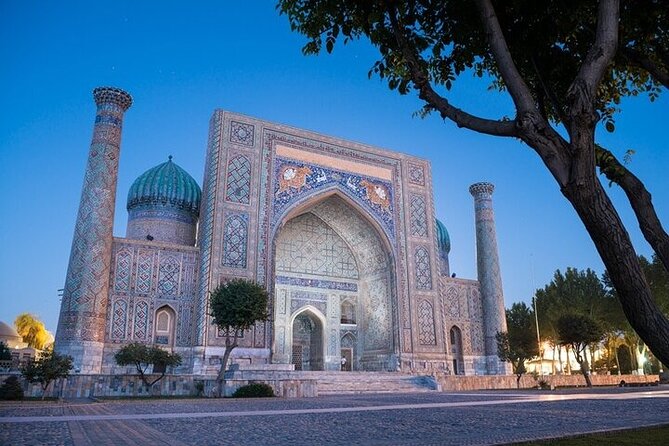
Registan is Samarkand’s signature public square. Three monumental madrasas frame the space: Ulugh Beg, Sherdor, and Tillokori. The square took its present form after the old city of Afrosiab declined, and it has been rebuilt more than once.
You have two hours here, the longest single stop of the day. That is appropriate. The three facades are packed with tilework, geometric patterns, and monumental entrances, and rushing through them would waste the point of coming to Samarkand.
Your guide is especially useful here for sorting out the three buildings and their different periods. Max has been praised for strong English and engaging explanations, while Beck and Dilshod have also led visitors through Samarkand with care. Guide assignments can change, but the experience provides a local guide in each city.
Gur Emir Mausoleum
Gur Emir is the tomb of Timur, the conqueror known in the West as Tamerlane. The mausoleum was built in 1404 and 1405 and has been reconstructed.
You spend about an hour here. The building is smaller and more intimate than the Registan, with a focus on the tomb, interior decoration, and Timur’s political legacy. I like the contrast: Registan shows public power and education, while Gur Emir brings the story down to one ruler and his dynasty.
Shah-i-Zinda
Shah-i-Zinda is an architectural complex on the southeastern rise of Afrosiab. It contains 44 tombs across more than 20 mausoleums, creating one of Samarkand’s most memorable sequences of decorated structures.
The scheduled visit lasts about an hour. Take your time with the tilework, but remember that this is a funerary site, not only a photo stop. Your guide can provide the religious and historical setting that gives the complex its meaning.
Bibi Khanym Mosque and Siab Bazaar
Bibi Khanym Mosque was built on Timur’s order between 1399 and 1404 and named after his wife. You have about 30 minutes here, which is enough for a focused visit but not a long pause.
The mosque is famous for its scale and connection to Timur’s building program. A short stop makes sense in this packed day, though you may wish you had more time if large architecture is your main interest.
Next comes Siab Bazaar, where you have about 30 minutes. The market is known for produce and handicrafts, and it offers a more ordinary, everyday side of Samarkand. This is a useful counterpoint to the ceremonial monuments. You see what people buy and sell, not only what rulers built.
Ulugh Beg Observatory
The final major sight is the observatory of Ulugh Beg, Timur’s grandson. Only the foundations remain, but the site reflects his work as an astronomer, scientist, and architect.
You spend an hour here. It is a good closing stop because it widens the story beyond conquest and religious buildings. Samarkand was also a place of scientific study, and the observatory gives that side of the city a proper place in the program.
After sightseeing, you transfer to Samarkand Railway Station and take the bullet train back to Tashkent. The experience ends at the original meeting point, but your own onward transfer is not included.
What the $500 price really covers
At $500 per person, this is not a bare train-and-hotel package. The price includes the three train journeys, two nights in a central three- to four-star or boutique hotel, two breakfasts, air-conditioned vehicle transfers, entrance tickets, taxes, and licensed guides in each city.
That bundle is the main value. You do not have to arrange separate tickets, station transfers between Bukhara and Kagan, monument admissions, or local guides. A 24-hour customer service line is also included, which matters when train seats, room arrangements, or last-minute changes need attention.
The hotels are described as comfortable and decent rather than luxurious. One person specifically found the accommodation suitable for the price, while another had a problem with a double room being arranged instead of the requested twin room. If bed type matters, confirm it in writing before arrival.
A single room costs an additional $40. Photography and video fees at museums are not covered and generally run $1 to $2 per site in cash. Tips for guides and drivers are also extra.
The price becomes especially attractive if you would otherwise pay separately for three train tickets, two hotel nights, private transfers, and two city guides. It is less appealing if you already have hotel reservations or prefer to arrange your own rail travel.
The private format and guide quality
The private setup is a real advantage. You are not tied to the needs of a large group, and your guide can answer your questions directly. The tour uses different guides in Bukhara and Samarkand, rather than one person accompanying you through every city.
English ability has been a strong point. Muhlio and Malika have been praised for clear English and detailed explanations in Bukhara. Max has received similar praise in Samarkand, and Beck and Dilshod have also been singled out for their English and considerate approach.
The operator has also handled difficult changes well in some cases. One guest had a delayed visa and needed the entire trip rearranged during a busy season. The coordinator, Hussaine, worked through the changes, while Umid provided quick help by message. That does not guarantee every request will be handled perfectly, but it suggests you have a reachable local contact when plans become complicated.
Still, do not assume every detail is immune to error. The incorrect room arrangement and one complaint about paying for Bukhara admissions show why you should check your room type and keep receipts. The operator offered a $20 refund for the mistaken entrance charges, which is a reasonable response, but avoiding the problem is better.
Who should book this three-day route
I would choose this tour if you have limited time and want the main monuments of Bukhara and Samarkand without managing every train, hotel, driver, and ticket yourself.
It suits:
- First-time visitors to Uzbekistan
- People who prefer private guiding
- History and architecture fans
- Travelers comfortable with early starts and full sightseeing days
- Visitors who want rail travel rather than long road transfers
- Couples or small groups who can share a room and private vehicle
I would think twice if you want long, unplanned mornings, slow museum visits, or several nights in each city. The route gives you breadth, not a leisurely pace. Tashkent is mainly the departure and return point, while Bukhara and Samarkand receive the real sightseeing time.
Older travelers or anyone sensitive to heat should ask about earlier summer start times. The schedule includes long walks and several outdoor areas, especially in Bukhara and around Samarkand’s monuments.
My verdict on the Tashkent, Bukhara, and Samarkand tour
Book it if you want an efficient first look at Uzbekistan and value having the moving parts arranged for you. The bullet train plan, private guides, included admissions, and central hotels make the $500 cost reasonable, especially for a short visit.
Do not book it expecting a relaxed cultural stay. The first day is long, the third day is packed, and train tickets depend on availability. Before paying, confirm the train schedule, pickup arrangements, twin or double room, and summer sightseeing times.
For a three-day introduction to Uzbekistan’s major Silk Road monuments, this is a strong practical choice. Give it more days if you can. If you cannot, this route gets you to the places that matter most with surprisingly little wasted time.
FAQ
Where does the tour start?
The tour starts at Toshkent Railway Station, also called Tashkent North Railway Station, at 7:30 a.m.
Can I request pickup in Tashkent?
Yes. Pickup can be requested if reaching the departure point is easier, but the included arrangements do not cover the first morning transfer to the railway station.
Which train routes are included?
The included bullet train route runs from Tashkent to Bukhara, Bukhara to Samarkand, and Samarkand back to Tashkent. Train travel is subject to availability.
Are hotel nights included?
Yes. The price includes two nights in a centrally located three- to four-star or boutique hotel, with twin or double room accommodation. A single room requires a $40 supplement.
Are monument entrance tickets included?
Yes. Entrance tickets to the listed monuments are included. Museum photography and video charges, usually $1 to $2 per site, are extra.
Is this a group tour?
No. It is a private activity for you and your own party, with guides in Bukhara and Samarkand.
What is not included at the end of the tour?
The final transfer from Tashkent Railway Station to your hotel or airport is not included. Tips, museum photography charges, and the single-room supplement are also extra.
Just added around Tashkent
- Private Intercity Transfer Tashkent – Samarkand – Tashkent★ 3.5 · 3 reviews
- Tashkent Mountain Tour Amirsoy with Transport★ 3.5 · 3 reviews
- Tashkent-Samarkand-Bukhara tour-3nights/4 days★ 5.0 · 5 reviews
- Amirsoy & Chimgan mountain tour from Tashkent★ 5.0 · 3 reviews
- Private Tashkent City Tour★ 5.0 · 3 reviews
- Tashkent Food and Metro Journey★ 5.0 · 4 reviews
- Transfer Tashkent Airport / Railway Station – Hotel★ 3.5 · 3 reviews
- Tashkent City Tour with Hotel Pickup and Drop off★ 4.5 · 4 reviews
Train Experiences, compared.
2 Days Tour to Bukhara and Samarkand from Tashkent by train
Read our review →
Afrosiyob high speed train tickets – Guaranteed Pass
Read our review →
Samarkand One Day Private Tour from Tashkent with Bullet Train
Read our review →
Samarkand Airport / Railway Station – Samarkand City Transfer
Read our review →
Uzbekistan 6 Days Private Tour Khiva-Bukhara-Samarkand by Train
Read our review →
Transfer Tashkent Airport / Railway Station – Hotel
Read our review →Browse the lists this tour appears in