

Reviewed · TRAIN EXPERIENCES
2 Days Tour to Bukhara and Samarkand from Tashkent by train
Samarkand’s blue-tiled monuments and Bukhara’s old trading streets are the main event here, but the real trick is the Afrosiyob high-speed train. In two tightly packed days, you cover the two most important historic cities in Uzbekistan without arranging separate transport, guides, and station transfers.
I like the efficient route and the fact that this is a private tour, so your group gets its own guide and driver. I also like the strong attention to timing, with train tickets, pickups, and city sightseeing arranged together. The drawback is simple: this is a fast trip, not a relaxed one. Expect long sightseeing days, early starts, and little room for wandering off schedule.
Key points to know before booking
- Two Silk Road cities in one short trip: Visit Samarkand on the first day and Bukhara on the second.
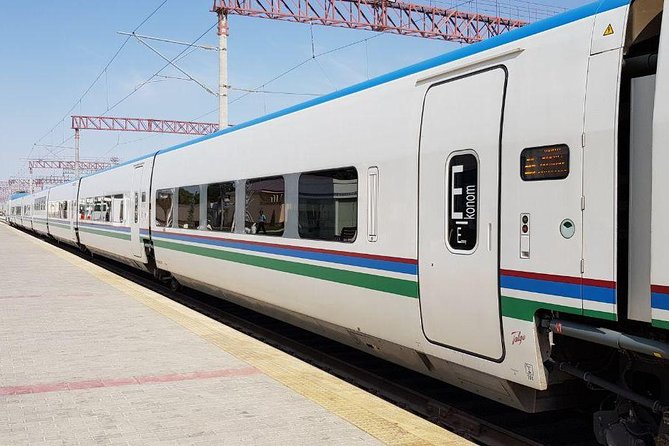
- Afrosiyob trains save valuable time: The schedule includes high-speed rail from Tashkent to Samarkand and from Bukhara back to Tashkent.
- Private guiding in each city: Your group travels with its own guides and driver rather than joining a large shared group.
- The sightseeing is monument-heavy: Registan, Shah-i-Zinda, Bibi Khanim, Poi Kalon, and the Ark all appear on the route.
- July can be brutally hot: One reported itinerary reached 41 degrees Celsius in Bukhara, with limited shade during the walking program.
- The $499 price buys convenience: It is most useful for you if time is short and you want transport, transfers, guides, and admissions handled together.
Why this route works for a short Uzbekistan visit
Uzbekistan rewards slow travel, but many people have only a few days. This tour makes a practical compromise. You use the fast rail network to reach Samarkand, spend the day on its major sights, continue toward Bukhara, then return to Tashkent by train the following afternoon.
That route matters because the cities are not next door. Organizing this independently means matching rail tickets with city transfers, finding guides in two places, and making sure you reach the right station at the right time. Here, those moving parts are handled for you.
You should think of this as a highlights tour. It gives you the great monuments and a useful first look at both cities. It does not give you long café stops, unplanned market wandering, or time to explore side streets at a slow pace.
The tour is private, and that improves the experience in practical ways. You can ask questions freely, adjust the pace slightly, and avoid being tied to the needs of a large group. It does not mean the schedule is loose. The train departures still set the rhythm of the trip.
A few more Tashkent trips to weigh up
- Tashkent Airport & Train Station Pick Up & Drop Off
★ 4.5 · 50 reviews - Day Tour to Samarkand from Tashkent by train.
★ 5.0 · 34 reviews - Uzbekistan 3 Day Private Tour Tashkent-Bukhara-Samarkand Bullet Train
★ 4.5 · 23 reviews
Samarkand begins with an early Afrosiyob departure
The first morning starts with a 7:00 transfer to Tashkent railway station. The Afrosiyob train leaves at 8:00 and reaches Samarkand at 10:08, giving you a little over two hours on the train.
That is a much better use of time than a long road transfer. Once you leave the Samarkand terminal, you meet the local guide and driver and begin sightseeing. The exact flow can vary, but the listed stops form a sensible introduction to the city’s major Islamic architecture and scientific past.
The early start is part of the bargain. You will want to be ready before breakfast or arrange anything you need the night before. The schedule is built around the train, so arriving late at the station is not a minor inconvenience.
Gur Emir, the setting for Samarkand’s great monuments
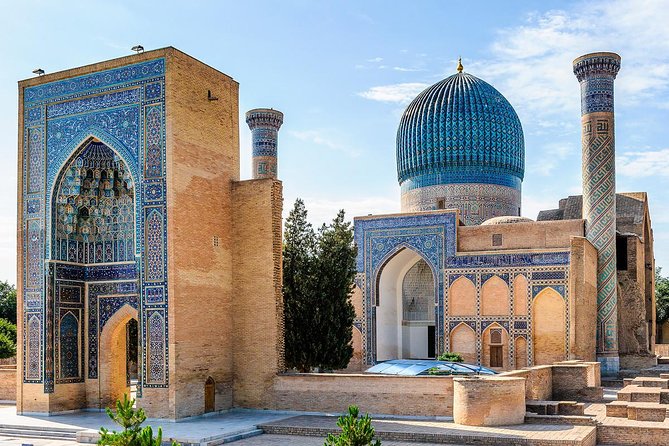
The first stop is Gur Emir Mausoleum, the grand tomb associated with Timur, the ruler known in the West as Tamerlane. Its blue dome and ornate tilework prepare you for the scale and color of Samarkand.
You get about an hour here, with admission included. That is enough to see the main interior and exterior details with a guide, though anyone who likes to study tile patterns or inscriptions closely may want more time.
Gur Emir also helps you understand Samarkand as a royal capital. The city’s monuments are not scattered accidents. They reflect the power, ambition, and court culture of the Timurid period.
Registan Square delivers the big Samarkand moment
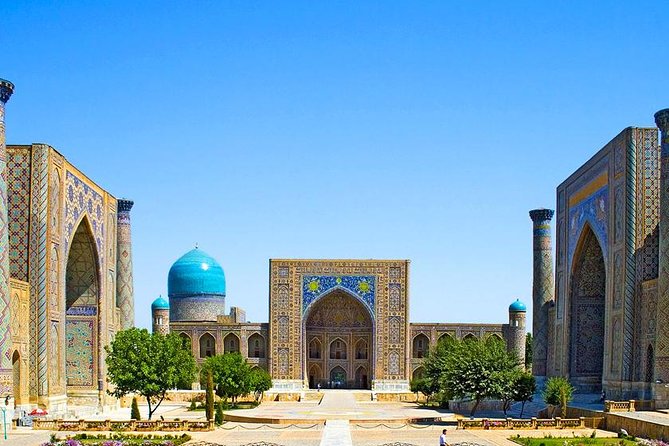
From Gur Emir, the route continues to Registan, Samarkand’s famous central square. It is framed by three huge madrassas: Ulughbek Madrassa, Sherdor Madrassa, and Tilla Kori Madrassa.
You have about an hour here, and admission is included. This is the stop where the tour’s pace may feel most noticeable. Registan deserves time for close viewing, photographs, and an explanation of how the three façades differ, but the schedule moves on.
I would use the guide’s time well. Ask about the geometric decoration, the animal imagery on Sherdor, and Ulughbek’s role as both ruler and scholar. The square is more than a photo stop, and a good guide can turn its decoration into a readable story.
Same Silk Road, a completely different kind of day:
- Best of Tashkent Mountains: Amirsoy, Chimgan & Charvak Trip
★ 4.8 · 567 reviews - Samarkand One Day Tour – Departure From Tashkent
★ 5.0 · 313 reviews - Tashkent City Tour
★ 5.0 · 121 reviews - Amirsoy, Chimgan & Charvak Full-Day Adventure
★ 4.9 · 82 reviews
Bibi Khanim shows Samarkand’s ambition
The Bibi Khanim Mosque receives about 30 minutes, with admission included. Its scale is the point. The complex was built to project the power of Timur’s Samarkand, and the large domes and monumental entrance make that clear.
Half an hour gives you a quick look, not a full study. If you want detailed architectural photography or a quiet pause, you may feel rushed. Still, after Registan, Bibi Khanim adds a useful contrast: Registan is a carefully composed square, while Bibi Khanim feels more like a vast statement of imperial force.
Shah-i-Zinda is the most intimate Samarkand stop
The Shah-i-Zinda Necropolis gets about an hour. This is one of the most rewarding stops on the route, especially if you enjoy close-up tilework rather than only grand open spaces.
The necropolis is a line of mausoleums with richly decorated façades. The passage narrows the view, bringing you close to the blue, turquoise, and patterned surfaces. It can feel more personal than the enormous squares.
An hour lets you walk through the main section with a guide. Wear comfortable shoes and keep your pace steady, since the day includes several stops and the wider schedule still has to get you to the station.
Observatory and Siyab Bazaar finish the Samarkand day
Ulugh Beg Observatory is a short but worthwhile stop for anyone interested in science. Ulugh Beg was an astronomer and ruler, and the observatory reflects Samarkand’s place as a center of medieval astronomical study.
The listed time is about an hour and also includes the Siyab Bazaar. The pairing works well. You move from scholarly Samarkand to everyday commercial life, where you can see the city’s market culture and browse local goods.
At 20:00, a transfer takes you to the railway station. The schedule then moves you onward, with Bukhara sightseeing beginning the next morning. The exact evening rail timing and accommodation details are not specified in the supplied program, so confirm those points before paying. Breakfast is listed on Day 2, but the hotel name and room arrangements are not provided.
Bukhara starts on foot at Lyab-i-Hauz
After breakfast, you meet the guide at 9:00 and begin a walking program. The first stop is the Lyab-i-Hauz ensemble, centered on a pool and surrounded by historic buildings.
The complex includes Nadir Divanbegi Madrassa, a khanaka, Kukeldash Madrassa, and a monument to Khodja Nasreddin. This is a good opening for Bukhara because the area brings together architecture, public space, and local storytelling.
You receive about an hour here. Since the Bukhara program is on foot, this is the point to assess your energy, water supply, and footwear. The city can be very hot, and much of the appeal comes from moving between open squares, lanes, and courtyards.
Magoki Attori offers a glimpse of older Bukhara
The next stop is Magoki Attari Mosque, one of the oldest surviving mosques in Bukhara. The visit lasts about 30 minutes and includes admission.
This stop is valuable because it shifts your attention away from the grandest buildings. You get a sense of the city’s older religious layers and the survival of an early mosque within the historic center.
Half an hour is enough for an introduction. It is not a long, quiet visit, so listen closely while the guide explains what makes the building important.
Trading domes bring craft and commerce into the tour
Bukhara’s old trading domes are among the most practical stops on the route. You visit Abdullakhan’s Tim, with shops selling souvenirs, ceramics, national clothes, and carpets. The program also includes Caravanserai Sayfuddin, a center for handicraft development, and three trading domes.
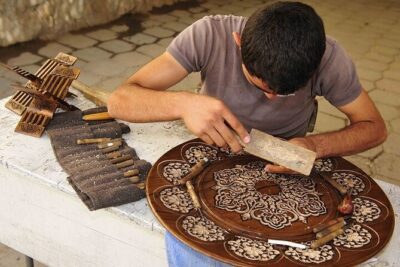
Allow about an hour. This is your chance to see crafts connected with the city’s traditional trading culture rather than only photographing monuments. You might find ceramics, textiles, carpets, and clothing, but the time is limited, so do not feel obliged to make a purchase.
A private guide can help explain what you are seeing and point out the difference between a historic trading space and a modern souvenir shop. Keep your expectations sensible. The tour gives you an introduction to the craft scene, not a full shopping day.
Poi Kalon is Bukhara’s grand visual centerpiece
The route continues to Poi Kalon Square, the heart of Bukhara’s old center. The complex includes the Kalon Minaret, Kalon Mosque, and Mir Arab Madrassa.
You have about an hour here. Admission to this stop is not included, so budget for an additional ticket. The square is one of the places where Bukhara’s architecture works best as a group. The tall minaret, broad mosque, and madrassa create a strong sense of scale without the huge open distances found at some of Samarkand’s monuments.
The Kalon Minaret is especially memorable. It served as a landmark for people approaching the city and remains one of Bukhara’s defining forms. Use your free moments to look at the relationship between the buildings, not only at the minaret itself.
The Ark gives you a final taste of Bukhara’s power
The final listed sight is the Ark Fortress, visited from the outside only. That detail matters. You should not expect an interior tour or a full exploration of the fortress grounds.
Even from outside, the Ark helps explain Bukhara’s political history. Its massive walls and raised position make it easy to picture the fortress as a center of rule. The stop is brief, about 30 minutes including the final transfer preparations.
At 14:50, you transfer to Bukhara railway station. The Afrosiyob train leaves at 15:50 and arrives in Tashkent at 19:44. A driver meets you after you exit the terminal for the final transfer.
The $499 cost: paying for speed and organization
At $499 per person, this is not the cheapest way to see Samarkand and Bukhara. The price makes more sense if you value time-saving rail travel, private guides, drivers, station transfers, and a ready-made schedule.
Admissions are included at Gur Emir, Registan, Bibi Khanim, Shah-i-Zinda, Lyab-i-Hauz, Magoki Attari, and the trading areas as listed. Admission is not included for Poi Kalon or the Ark, and you should confirm the exact ticket costs before departure.
The value also depends on your group size. Group discounts are offered, but the exact reduction is not given. A larger private group may find the per-person cost easier to justify, while a solo visitor should compare it with the cost of booking trains, guides, and transfers separately.
I would not choose this tour because it is cheap. I would choose it because it compresses a complicated route into a plan that is easy to follow.
Guides, communication, and the private format
The tour uses guides in the individual cities, and names associated with the service include Nodir in Samarkand and Shahrukh in Bukhara. Both have been described as friendly, well informed, and strong in Japanese. Other coordination has included people such as Aynur and Mumin.
That matters if language support is important to you. The supplied information does not promise a particular guide or language for every departure, so confirm your preferred language when booking.
The private format is also useful for solo visitors and small groups. One Japanese-language account describes a woman traveling alone and feeling both safe and well supported. That does not guarantee every departure will feel identical, but it suggests the service pays attention to coordination and personal support.
The overall service record is strong, with a 4.9 rating from 53 reviews and a 98 percent recommendation rate. Treat those numbers as a helpful signal, not a promise that the pace or heat will suit everyone.
Heat, walking, and the pace you should expect
The biggest practical issue is weather. A July visit can reach 41 degrees Celsius in Bukhara, and the walking route has limited shade. A six-hour city walk in that heat would test even fit people, so pack water, sun protection, and light clothing.
The timetable lists individual stops adding up to a busy day, and transfers are fixed around the trains. You should be comfortable walking for several hours and getting back on the schedule after each monument.
Spring and cooler months are likely to make the experience easier, but the supplied information does not give seasonal operating details. Ask about the forecast and the walking load before you commit.
Who should book this two-day Uzbekistan tour
I would recommend it for you if:
- You have only a short stay in Uzbekistan.
- You want the main monuments in Samarkand and Bukhara.
- You prefer a private guide and driver.
- You like an active, tightly planned trip.
- You value organized rail travel more than a low price.
- You want help with station transfers and local sightseeing.
I would look elsewhere if you want slow mornings, long meals, independent exploration, or time inside every monument. Bukhara especially deserves more than a quick walking circuit, and Samarkand’s major sights can easily fill a full day on their own.
Should you book it?
Book this tour if your priority is seeing the essential Samarkand and Bukhara sights with minimal planning. The Afrosiyob trains, private guides, and coordinated transfers make a difficult short route manageable, and the monument selection is strong.
Before booking, confirm the hotel, the exact evening connection between Samarkand and Bukhara, your guide language, and the extra admission costs at Poi Kalon and the Ark. If you can handle early starts and a hot, active schedule, the $499 price can be fair for the convenience. If you have more time, add extra nights and see both cities at a slower pace.
FAQ
How long is the tour?
The tour is scheduled for approximately two days. The program begins with a 7:00 transfer in Tashkent on Day 1 and ends with arrival in Tashkent at 19:44 on Day 2, followed by a driver transfer.
Which train is used?
The tour uses the Afrosiyob high-speed train for the journey from Tashkent to Samarkand and the return journey from Bukhara to Tashkent.
Is this a private tour?
Yes. Only your group participates in the private tour or activity.
Is pickup available?
Yes. Pickup is offered, and the program includes transfers to and from the railway stations.
Are admission tickets included?
Admission is included for Gur Emir Mausoleum, Registan, Bibi Khanim Mosque, Shah-i-Zinda, Lyab-i-Hauz, Magoki Attari Mosque, and the trading dome visits. Admission for Poi Kalon and the Ark is not included.
Can I cancel for a full refund?
Yes, if you cancel at least six full days before the local start time. Cancellations made two to six full days before the start time receive a 50 percent refund. Cancellations made less than two full days before the start time are not refunded.
Just added around Tashkent
- Private Intercity Transfer Tashkent – Samarkand – Tashkent★ 3.5 · 3 reviews
- Tashkent Mountain Tour Amirsoy with Transport★ 3.5 · 3 reviews
- Tashkent-Samarkand-Bukhara tour-3nights/4 days★ 5.0 · 5 reviews
- Amirsoy & Chimgan mountain tour from Tashkent★ 5.0 · 3 reviews
- Private Tashkent City Tour★ 5.0 · 3 reviews
- Tashkent Food and Metro Journey★ 5.0 · 4 reviews
- Tashkent City Tour with Hotel Pickup and Drop off★ 4.5 · 4 reviews
- Silk Road Secrets Tour in Uzbekistan★ 5.0 · 4 reviews
Train Experiences, compared.
Uzbekistan 3 Day Private Tour Tashkent-Bukhara-Samarkand Bullet Train
Read our review →
Afrosiyob high speed train tickets – Guaranteed Pass
Read our review →
Samarkand One Day Private Tour from Tashkent with Bullet Train
Read our review →
Samarkand Airport / Railway Station – Samarkand City Transfer
Read our review →
Uzbekistan 6 Days Private Tour Khiva-Bukhara-Samarkand by Train
Read our review →
Transfer Tashkent Airport / Railway Station – Hotel
Read our review →Browse the lists this tour appears in