
Reviewed · BUKHARA TOURS
A Complete Chapter To Old Bukhara
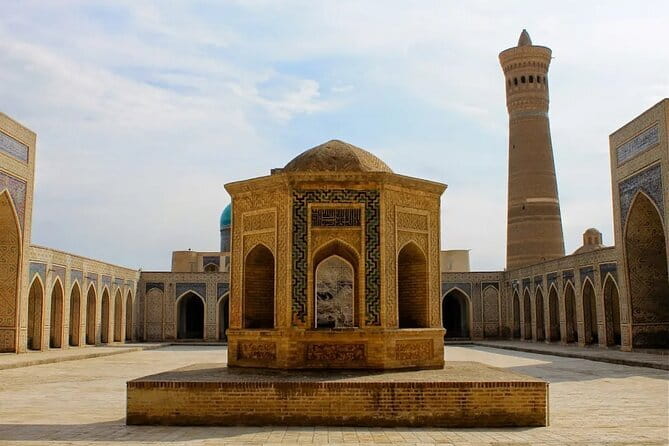
Bukhara is best understood on foot, and this tour gives you a clear route through its old center, from Bolo Hauz Mosque and the Ark to the Kalon Minaret, grand madrasas, and a local bazaar. Guide Hamza explains Central Asian history in plain, engaging terms, with time to connect the monuments to Bukhara’s customs and daily life.
I like the small maximum of 10 people, which should make it easier to hear and ask questions. I also like the finish near Ismail Samani Mausoleum, where you may have time to browse the local bazaar. The main consideration is that several stops are brief, and entrance fees, drinks, transport, and taxes are not included.
Key things to know before booking
- Hamza focuses on context, not just photographs: His explanations cover Bukhara and wider Central Asian history, with special appeal for history-minded visitors.
- The route is entirely on foot: Plan on three to four hours of walking, with the final stop near Ismail Samani Mausoleum and a local bazaar.
- You see many of Old Bukhara’s major landmarks: The Ark, Bolo Hauz Mosque, Kalon Minaret, Mir-i-Arab Madrasa, and several other historic schools and mosques are part of the route.
- The group is capped at 10 people: This is small enough for a more personal guide experience than a large city tour.
- Some admissions cost extra: The Magoki Attori Mosque and carpet museum, Kosh Madrasah, Abdulaziz-Khan Madrasah, and Mir-i-Arab Madrasa list entrance fees as not included.
- The bazaar adds a local-life finish: If it is open, you can explore after the formal tour ends.
Why this walking tour is a useful introduction to Bukhara
Bukhara can feel like a history book built from brick, tile, domes, and shaded lanes. A first visit may leave you admiring beautiful buildings without knowing why they matter. This tour helps connect the pieces.
For about three to four hours, you move through major religious, royal, and educational sites in the old city. The route is not built around one single monument. Instead, it gives you a broad look at how Bukhara developed as a center of faith, scholarship, trade, and political power.
That wider view is the tour’s main strength. Hamza’s explanations are especially suited to you if you want more than a list of construction dates. The published comments about his guiding repeatedly praise clear explanations, a good grounding in Central Asian history, and the way he presents Bukhara from a fresh angle.
This is not a transport-based sightseeing trip. You walk from stop to stop, which lets you see the old center at street level. It also means you should wear comfortable shoes and allow for a pace that can change depending on the group, weather, and how long the guide spends answering questions.
Other Bukhara days people book alongside this one:
- Best of Bukhara: All Day Private Old Town Tour
★ 5.0 · 66 reviews - Best of Bukhara: All Day Private Old Town Tour
★ 4.9 · 62 reviews - City Tour Around Bukhara
★ 5.0 · 55 reviews
Starting at Magoki Attori Mosque and its carpet museum
The meeting point is Magoki Attori Mosque and carpet museum on Mekhtar Anbar Street. This is a useful starting place because the site brings together several layers of Bukhara’s past in one setting.
The mosque is one of the historic religious buildings in the old city, while the carpet museum adds a more hands-on cultural angle. Carpets are not just decorative objects in Central Asian culture. Their patterns, materials, and uses can tell you about craft traditions and the practical life of the region.
Admission to the mosque and museum is not included, so ask Hamza at the beginning which parts of the complex require a separate payment. The published details are not fully consistent about exactly which admissions are covered, so it is sensible to carry some local currency or payment method for optional entries.
The stop also sets the tone for the walk. You are not starting with a quick photo at a major square. You begin with a place tied to worship, craft, and the long story of Bukhara’s old quarter.
Bolo Hauz Mosque and the royal side of Bukhara
Bolo Hauz Mosque is listed as a short five-minute stop, with admission included. Its name is associated with the pond in front of it, and the site gives you a sense of how water shaped public spaces in an old desert city.
The mosque is known for its graceful wooden columns and painted ceiling. Even with limited time, look upward and pay attention to the repeated shapes and colors. The building rewards close observation more than a quick wide photograph.
This part of the walk also helps introduce Bukhara’s royal district. Bolo Hauz Mosque is located near the Ark, the old fortified citadel, so the transition from mosque to fortress is a reminder that religion and government were closely linked in the city’s historic center.
Because the stated stop lasts only five minutes, do not expect a long interior visit or an extended photography session. If this building particularly interests you, tell Hamza early in the tour. A small group makes that sort of request more practical, though the overall schedule still has to be respected.
The Ark of Bukhara and the city’s power center
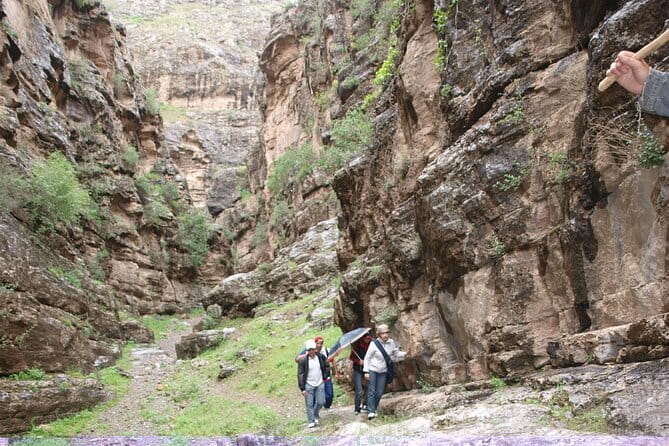
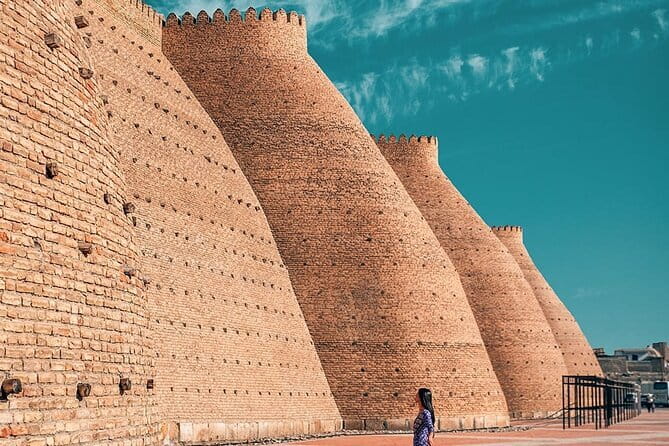
The Ark is one of the essential sights in Bukhara. This massive citadel served as the seat of government and the residence of rulers. Its walls are more than a dramatic backdrop. They represent the city’s political heart.
The provided schedule does not give a fixed time for the Ark, so this may be one of the places where the guide adjusts the pace. Ask questions here about how the citadel functioned and how it related to the surrounding city. The value of a guide is strongest at places like this, where the walls alone cannot explain the full story.
You may not receive a full museum visit inside the Ark as part of the stated tour. The experience is primarily a walking tour, and the route includes several exterior views and short stops. If you want a detailed exploration of every museum room, you may need to return independently.
Still, seeing the Ark in relation to Bolo Hauz Mosque and the central monuments gives you a useful mental map. You begin to understand Bukhara as a working city with rulers, worshippers, scholars, craftspeople, and traders sharing a compact old center.
Same Silk Road, a completely different kind of day:
- Bukhara Full Day Old City Private Tour
★ 5.0 · 46 reviews - Yurt Camp Tour with Night from Bukhara
★ 3.8 · 35 reviews - All You Need To Know About Bukhara. A Walk In The Town
★ 4.9 · 31 reviews - One-Day Private Tour in the Old Town of Bukhara
★ 5.0 · 24 reviews
The Kalon Minaret and Bukhara’s best-known view
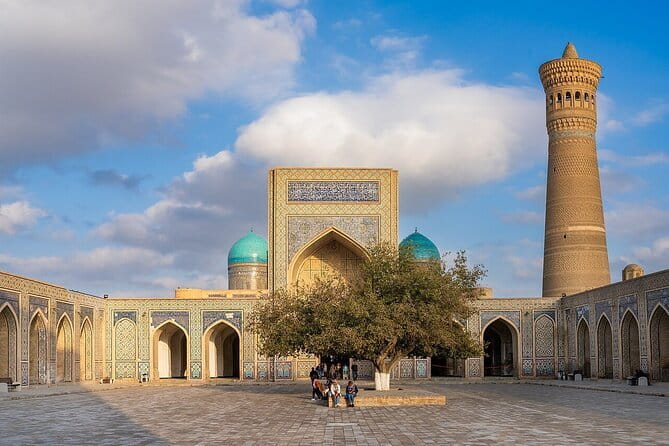
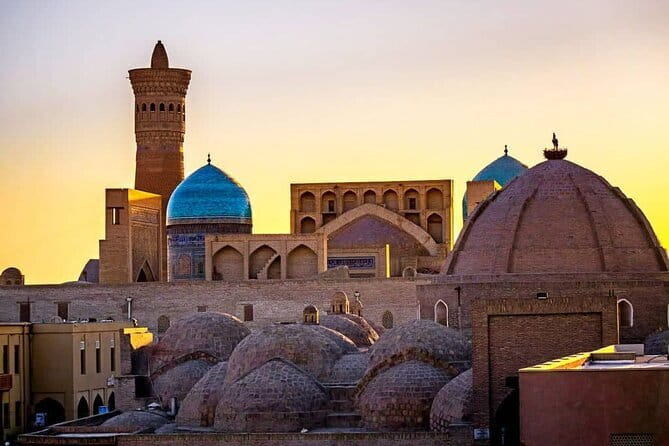
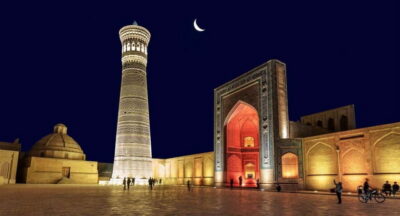
The Great Minaret of the Kalon appears twice in the route, first as a five-minute stop and later as another short viewing point. That repetition is practical. You may see it from different angles as you move through the old center, and the minaret is one of the easiest landmarks to use for orientation.
The Kalon Minaret is famous for its height, patterned brickwork, and long connection to Bukhara’s religious center. It is not simply a tower to photograph. Its scale shows the ambition of the people who built and maintained the surrounding complex.
The first stop is listed as free, while a later entry is listed as included. Since the notes also say that all fees and taxes are not included, clarify with the guide what is covered if you are offered an interior visit or a paid viewpoint.
The short scheduled stops suggest that the minaret is mainly used as a landmark and interpretation point. You will get the key story and a chance to see it, but you should not assume unlimited time around the complex.
Ulugbek Madrasa and the scholarly tradition
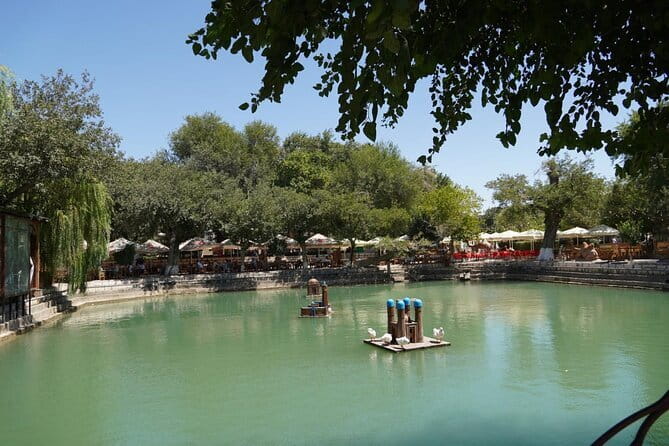
Ulugbek Madrasa receives a five-minute stop with admission listed as free. The madrasa connects Bukhara to the region’s long tradition of Islamic learning and scholarship.
A madrasa was not merely a decorative school. It was a place where students studied religion and related fields, and its presence in the old city reflects Bukhara’s role as a center of learning. Hamza’s Central Asian history background is especially useful here because the significance of these buildings reaches beyond their façades.
The time is short, so concentrate on the entrance, tilework, proportions, and the guide’s explanation. If you like architectural detail, you may want to note the layout and return later at your own pace.
This is one reason the tour works well as an orientation walk. You get enough background to decide which monuments deserve a second visit, rather than trying to understand every site in isolation.
Magoki Attori Mosque, carpets, and layers beneath the city
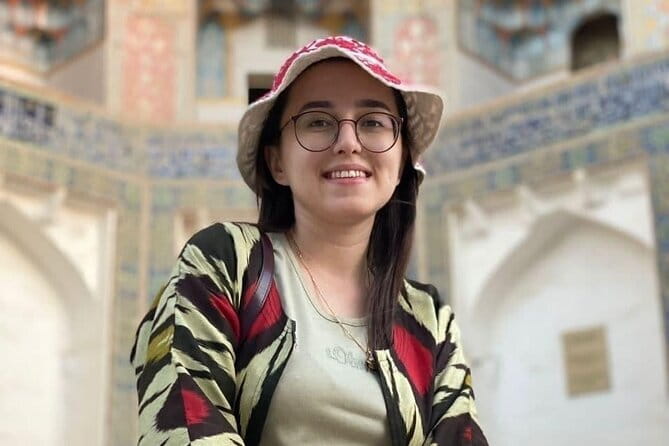
Returning to the Magoki Attori area gives the route a stronger cultural thread. The mosque and carpet museum bring together religious architecture and local craft, two parts of Bukhara’s identity that are easy to separate when sightseeing on your own.
The stop is listed as a five-minute visit, but admission is not included. You should treat the museum visit as an optional extra unless Hamza confirms otherwise. This is also a good place to ask about carpet-making traditions and the role of textiles in homes, trade, and regional identity.
The site is valuable because Bukhara is not only a city of grand monuments. Its culture is also found in objects made by hand and in the skills passed from one generation to the next. The tour’s promise of exploring traditions is most concrete here.
If you are mainly interested in large architecture, this stop may feel less dramatic than the Ark or Kalon Minaret. If you like material culture and local crafts, it may be one of the more rewarding parts of the walk.
Kosh Madrasah and Abdulaziz-Khan Madrasah
Kosh Madrasah is a very brief viewing stop, listed at two minutes. The name refers to a paired madrasa arrangement, and the stop works best as a quick architectural comparison rather than a full visit.
Abdulaziz-Khan Madrasah follows with another two-minute viewing stop. Its decoration is among the reasons this building deserves attention, but the schedule suggests that you will mainly see it from outside or make a short visit.
Neither admission is included. Carrying extra money is wise if the guide offers entry and the buildings are open. At the same time, do not judge the tour by expecting long interior explorations at every madrasa. The route covers a large number of sites, so the tradeoff is breadth over depth.
I like this approach for a first day in Bukhara. You get a sweep of the old city and can mark the places you want to revisit. If your priority is detailed architectural study, a private tour with longer stops may suit you better.
Mir-i-Arab Madrasa and the central religious quarter
Mir-i-Arab Madrasa is another important landmark near the Kalon complex. The tour includes a short viewing stop, with admission not included.
Its position helps you see how closely Bukhara’s major religious buildings are grouped. The minaret, mosque, and madrasa form a powerful architectural center, and Hamza can explain how these institutions fit into the city’s religious and educational life.
Again, the scheduled time is only about two minutes. That is enough for a quick look and orientation, not a slow examination of every detail. Take a moment to look across the square, compare the building’s scale with nearby structures, and listen for the historical connections.
The route’s repeated use of short stops may frustrate you if you prefer a relaxed pace. It helps if you see this experience as a guided introduction rather than a complete study of every monument.
Ending near Ismail Samani Mausoleum and the bazaar
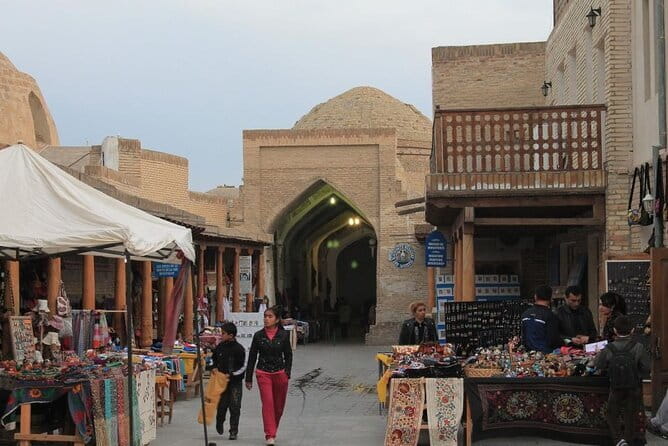
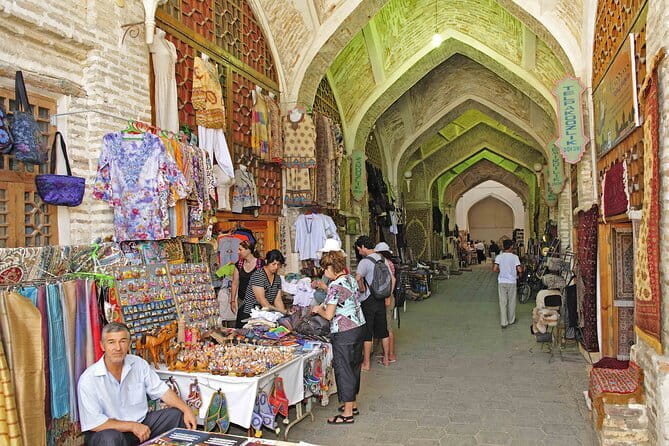
The walk ends near Ismail Samani Mausoleum, close to a local bazaar. This is a useful finish because it shifts the focus from formal monuments to everyday commerce.
The mausoleum is one of Bukhara’s best-known historic structures, and its brick construction gives you a different visual experience from the glazed tile and monumental façades elsewhere on the route. The exact amount of time at the mausoleum is not specified, so ask Hamza whether the final stop is a guided visit or an exterior look.
Afterward, you may have time to explore the bazaar if it is open. That condition matters. Bazaar hours can vary, and the tour does not guarantee that it will be operating when you arrive.
I like this ending because you can continue at your own pace. Use the bazaar for a look at local goods and daily trading, or simply treat it as a practical place to orient yourself after the walk. One published comment singled out the bazaar portion as particularly enjoyable, and it is easy to see why. A market gives you a different view of Bukhara than monuments alone.
What the $55 price includes
At $55 per person, the price is reasonable if you want a guide to connect many major sights during a half-day walk. The fee includes guide service, the walking tour, 24/7 support, help with other bookings, and general assistance.
The value depends on how much you use the guide’s explanations. If you only want photographs of the main landmarks, you can see much of the old center independently. If you want help placing Bukhara within Central Asian history, the fee becomes easier to justify.
Group discounts may improve the price for larger bookings, though the maximum group size is 10 people. Transport is not included, and neither are coffee, tea, all fees, or taxes. Several monument or museum entries also list admission as extra.
The best way to judge the cost is to think of it as payment for structure and interpretation, not an all-inclusive sightseeing pass. You are paying for a planned route, a local guide, and help making sense of what you see.
Pace, group size, and practical planning
The tour usually takes three to four hours, but the duration can change because it is a walking experience. The number of stops is high, and several are short, so the guide may adjust the timing based on questions, weather, and opening conditions.
The maximum of 10 people is a useful middle ground. You get more personal contact than on a large coach tour, but the experience may still feel less flexible than a private walk.
Confirmation arrives at booking, and the meeting point is near public transportation. The start is at Magoki Attori Mosque and carpet museum, while the finish is near Ismail Samani Mausoleum and the bazaar. Check both points on a map before setting out, since the start and end are in different parts of the old city.
Free cancellation is available up to 24 hours before the start time. Changes made inside that window are not accepted, and poor weather or too few bookings can lead to a rescheduled tour or full refund.
Who should choose this Bukhara tour?
I would choose this walk if you are visiting Bukhara for the first time and want a broad, guided introduction. It is especially suitable for you if Central Asian history, religious architecture, old schools, and local culture are high on your list.
The experience also suits independent visitors who like to explore afterward. The guide gives you a route and background, then the bazaar and the city’s old streets leave room for your own wandering.
You may want another option if you need full accessibility information, long interior visits, or guaranteed entry to every monument. The tour data says most people can participate, but it does not give detailed accessibility notes. Since the walk lasts several hours, ask before booking if you have mobility concerns.
Should you book A Complete Chapter To Old Bukhara?
Book it if you want a compact, history-focused walk led by Hamza, with the city’s major monuments tied together in one route. The strongest reasons are the clear explanations, the small group limit, the range of sites, and the chance to finish with a local bazaar.
Go in with realistic expectations. This is not an all-entrance museum tour, and several stops are only a few minutes long. You will need to pay some admissions separately, arrange your own transport, and accept that the bazaar is available only if it is open.
For a first look at Bukhara, I think the balance is good. You get the Ark, Bolo Hauz Mosque, Kalon Minaret, several madrasas, Magoki Attori Mosque, the Ismail Samani Mausoleum area, and a guide who can help the city’s history make sense. If those priorities match yours, $55 is a fair price for the introduction.
FAQ
How long does the Bukhara walking tour last?
The tour lasts approximately three to four hours. The exact duration can vary because it is a walking tour.
Where does the tour start?
The tour starts at Magoki Attori Mosque and carpet museum, on Mekhtar Anbar Street 55 in Bukhara.
Where does the tour end?
The tour ends near Ismail Samani Mausoleum, close to a local bazaar. You may have time to explore the bazaar if it is open.
Is transport included?
No. Transport is not included, and the experience is designed as a walking tour.
Are entrance fees included?
Some entries are included or free, while several sites list admission as not included. Coffee, tea, all fees, and taxes are also not included.
How many people can join the tour?
The experience has a maximum of 10 participants. Group discounts are available.
Just added around Bukhara
- Full-Day Private Guided Tour to Islamic 7 Saints of Bukhara★ 4.5 · 3 reviews
- Bukhara Walking Tour★ 5.0 · 4 reviews
- Bukhara in a Day History, Culture, and Local Insight Private Tour★ 5.0 · 4 reviews
- 2 Day Ukhum Hiking Tour from Bukhara★ 5.0 · 4 reviews
- Uzbekistan 8 Days Private Guided Tour★ 4.6 · 3 reviews
- Bukhara: Full-Day Guided Tour with English-Speaking Guide★ 5.0 · 4 reviews
- 2 – Days Guided Tour of Samarkand and Bukhara from Tashkent★ 5.0 · 5 reviews
- 9 Days Private Guided Tour to Uzbekistan★ 5.0 · 3 reviews
Bukhara Tours, compared.
All You Need To Know About Bukhara. A Walk In The Town
Read our review →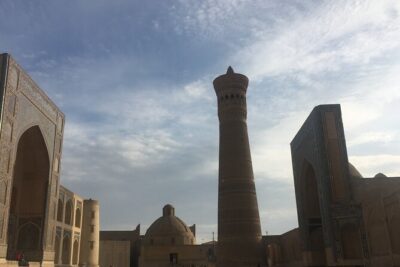
Bukhara Historical City Highlights Guided Walking Tour
Read our review →
Browse the lists this tour appears in