
Reviewed · CITY TOURS
Samarkand: Walking Tour around Old City
Samarkand’s greatest sights line up on this walk like chapters in a history book: Amir Temur’s mausoleum, the three madrasahs of Registan, Bibi-Khanum Mosque, Hazrat Khizr Mosque, and the blue-tiled Shah-i-Zinda necropolis. The clever part is the order, which moves from the city’s national hero to its grandest architecture and then into its most intimate sacred spaces.
I like the small group of no more than 10 people, which should make it easier to ask questions and hear the guide. I also like the focus on stories, from the supposed curse of Temur’s tomb to the lions on Sher-Dor and the artisans buried at Shah-i-Zinda. The main drawback is simple: this is a serious 3.5-hour walk, with little shelter from the sun, so comfortable shoes, water, and modest clothing matter.
Key points at a glance
- Five major monuments in one walking route: The tour covers Gur-e-Amir, Registan, Bibi-Khanum, Hazrat Khizr, and Shah-i-Zinda.
- Faridun leads the experience: His explanations cover Timurid rulers, architecture, local life, and traditions in English or Russian.
- A real history lesson, not just photo stops: You hear about Ulugh Beg’s astronomy, Temur’s burial, Islamic education, and the role of Samarkand as a Timurid capital.
- A strong final stop: Shah-i-Zinda brings together more than 20 mausoleums, striking tilework, and a quiet sacred atmosphere.
- Good value at $26: You receive roughly three and a half hours of guiding at the city’s key historic sites, though meals and transport are extra.
- Come prepared to walk: The route includes about 10 minutes at the opening monument, one hour at Gur-e-Amir, one hour at Registan, and further walking through the eastern monuments.
Why this route works for a first look at Samarkand
Samarkand can feel like a collection of magnificent monuments scattered through a large city. This tour gives you a clear thread. You begin with Amir Temur, the ruler who made Samarkand the capital of the Timurid Empire, then follow his dynasty through mausoleums, schools, mosques, and royal memorials.
That sequence helps you understand why the monuments look related. The blue tiles, geometric decoration, monumental entrances, and domes are not isolated design choices. They belong to a period when Samarkand was being reshaped as a center of rule, learning, religion, and art.
You also get more than architecture. The guide connects the old city with modern Uzbekistan, including the nearby tomb of Islam Karimov, the country’s first president. This gives you a useful bridge between medieval Samarkand and the nation you are visiting today.
The tour is listed at $26 per person, a reasonable price for a live guide and visits to five major sites. You are paying for interpretation as much as access. Without a guide, the tilework is easy to admire but harder to place in time, and the stories behind the buildings can be difficult to sort out.
A few more Samarkand trips to weigh up
- Samarkand: Historical Monuments Guided Walking Tour
★ 4.8 · 446 reviews - Samarkand One Day Tour: one day walking & group tour
★ 4.4 · 87 reviews - Samarkand: Historical Monuments Group Walking Tour
★ 5.0 · 29 reviews
Starting beneath Amir Temur’s statue
The meeting point is the monument to Amir Temur on University Boulevard Street. Look for the equestrian statue and cross the pedestrian crossing carefully. This is a practical place to begin because the monument gives you your first orientation to Samarkand’s modern public space and its national story.
Amir Temur, also known as Tamerlane, founded the Timurid Empire and made Samarkand his capital. The opening talk covers his early life, military campaigns, and the reason he remains a national hero in Uzbekistan. You also learn about the symbolism of the statue and the layout of the surrounding park.
This first stop lasts about 10 minutes. It is mainly an introduction and photo opportunity, not a long historical lecture. From here, the route quickly turns toward the older monuments.
Gur-e-Amir and the story of Temur’s tomb
The walk to Gur-e-Amir leads you to one of the finest examples of Timurid architecture. The mausoleum is easy to recognize by its blue ribbed dome, intricate mosaics, and strong sense of ceremony. Allow about an hour here, since this is more than a quick exterior stop.
Gur-e-Amir was built as a royal burial place and became closely tied to Amir Temur after his death in 1405. Inside, you see the burial sites of Temur, Ulugh Beg, and other members of the ruling family, including sons and grandsons.
The guide explains the famous curse associated with Temur’s tomb and the Soviet opening of the burial site in 1941. These stories add drama, but the more important value is seeing how the mausoleum connected political power with religious memory. The Timurid rulers were not simply placing bodies in a vault. They were creating a place that preserved dynastic authority.
Look closely at the dome and surface decoration. The building’s power comes from proportion as much as color. A guide can point out details that disappear when you are focused only on getting the classic photograph.
Gur-e-Amir is also a useful warm-up for the Registan. Its decoration is elaborate, but the scale remains manageable. You can study the craftsmanship at close range before confronting Samarkand’s largest architectural set piece.
Registan Square and three Timurid-era visions
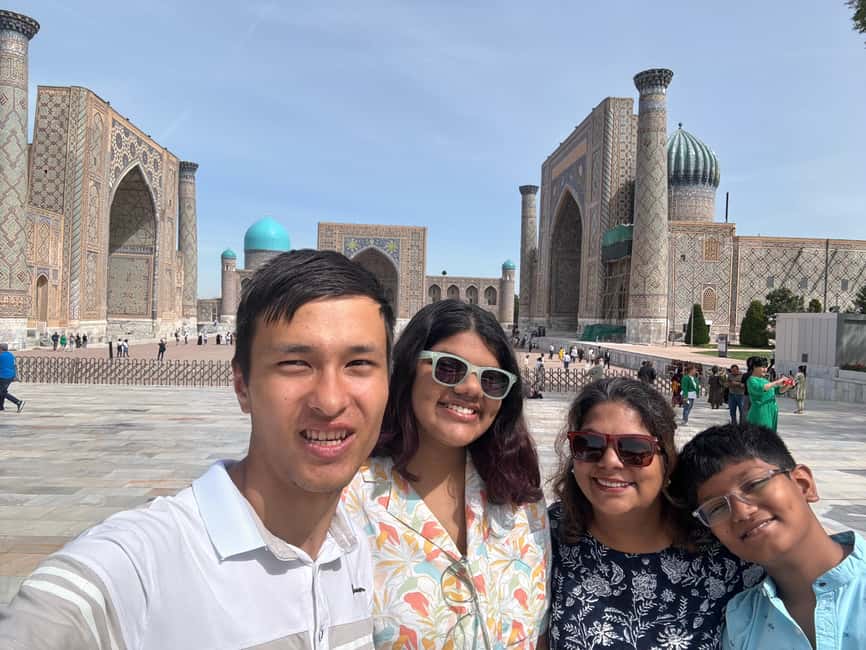
Registan receives about an hour, and it deserves that time. The square is framed by three madrasahs: Ulugh Beg, Sher-Dor, and Tilla-Kari. Together they form one of Central Asia’s most memorable urban spaces.
A madrasah was an Islamic school, but Registan was also a place for public life. The guide explains how the square functioned as a center of education and civic activity. You learn why Ulugh Beg matters not only as a ruler but also as an astronomer, and how science and religion could share the same intellectual world.
Ulugh Beg Madrasah is linked to his interest in astronomy and learning. Sher-Dor is known for the unusual sun and lion imagery above its entrance. The decoration is worth hearing about because the images raise questions about Islamic art and the particular visual language used in this building.
Tilla-Kari completes the group with its gold-covered interior decoration. The name means decorated with gold, and the building rewards a slower look inside. The tour allows time for photographs, souvenir browsing, and exploring the interiors rather than rushing through the square.
Registan is the busiest-feeling part of the experience simply because it is Samarkand’s best-known sight. Your one-hour visit gives you time to step back and appreciate the symmetry, then move closer to inspect tile patterns and inscriptions. If you want quiet photographs, the guide cannot control the number of other people in the square, but the small group should keep your own visit manageable.
Same Silk Road, a completely different kind of day:
- Private Samarkand City Tour With Transportation
★ 5.0 · 149 reviews - A City Tour Of Samarkand: The Pearl Of The East
★ 5.0 · 133 reviews - Full Day Private Tour in Seven Lakes from Samarkand
★ 5.0 · 94 reviews - Samarkand: Shahrisabz Day Trip with Optional Local Guide
★ 4.9 · 81 reviews
Bibi-Khanum and a mosque built for Temur
From Registan, the route continues to Bibi-Khanum Mosque for roughly 30 minutes. The mosque was commissioned by Amir Temur and is associated with his beloved wife. Its size and romantic backstory make it one of the most emotionally charged stops on the walk.
The story includes a jealous architect, though the building itself is the real reason to linger. Bibi-Khanum was once among the largest mosques in the Islamic world. Its monumental scale shows the ambition of Temur’s Samarkand, where architecture was used to announce the strength of the empire.
You can see large marble Qur’an stands and the remains of a complex that suffered serious damage over time. The guide also covers modern restoration, which is useful because parts of the mosque may look newly repaired while other areas show age and loss.
The short visit is enough for an introduction and photographs, but it is less time than Gur-e-Amir or Registan. If Bibi-Khanum is your personal priority, you may want to return later for a slower look. On this route, its role is to show another side of Timurid ambition: not a tomb or school, but a vast place of worship.
Hazrat Khizr and views across old Samarkand
The next section takes about 20 minutes and leads to Hazrat Khizr Mosque. This is one of Samarkand’s oldest functioning mosques, dedicated to Khizr, the immortal saint associated with protection for travelers.
The mosque matters for both its religious role and its position above the city. From here, you get panoramic views toward Shah-i-Zinda and the older parts of Samarkand. After several monumental interiors, this pause gives you a chance to look outward and understand how the historic sites relate to one another.
Nearby is the tomb of Islam Karimov, Uzbekistan’s first president. Its inclusion adds modern political context without pulling the tour away from the medieval core. You see how national memory is layered in the same part of the city.
Respectful clothing is recommended for mosque visits. Wear comfortable clothes that cover shoulders and knees, and remember that photography is allowed at most sites, not necessarily without limits everywhere. Ask the guide before photographing sensitive religious spaces.
Shah-i-Zinda, the quiet finish
The final stop is Shah-i-Zinda, usually visited for about 40 minutes with some free time. The name means The Living King, and the site is a necropolis built between the 11th and 15th centuries.
More than 20 mausoleums line the complex. Their blue tiles, star-shaped domes, narrow passageways, and detailed facades create a very different experience from the open scale of Registan. Here, the impact comes from close work and quiet repetition rather than one enormous square.
The complex includes the tomb of Qusam ibn Abbas, described as a cousin of the Prophet Muhammad. You also hear about Timurid princesses, court figures, and the artisans whose work survives in the tile patterns.
Shah-i-Zinda is the strongest ending because it brings the tour down to a human scale. You move past individual memorials and burial places instead of looking at one royal project from a distance. The silence also changes the pace. After several hours of explanation and photographs, the site gives you room to simply look.
The route includes steps and extended walking, so this is where footwear matters most. Comfortable shoes are not a formality. Sandals or stiff city shoes could make the final part less pleasant.
How Faridun guides the experience
Faridun is the named experience provider, and the available booking information identifies English and Russian as the tour languages. Recent descriptions of his guiding style emphasize detailed historical explanations, patience with questions, and a friendly approach that adapts to the group’s interests.
That matters in Samarkand because the names come quickly: Amir Temur, Ulugh Beg, Sher-Dor, Tilla-Kari, Bibi-Khanum, Qusam ibn Abbas, and Islam Karimov. A guide who pauses to explain how these people and places connect can turn a string of monuments into a story you can remember.
One recent booking refers to the guide as Frank rather than Faridun. If the name matters to you at the meeting point, confirm it when you reserve. The core information remains clear: the experience is designed as a live, small-group walk, with a guide who can answer questions in English or Russian.
The pace appears suited to curious adults who want context without being hurried. One recorded outing lasted from 9 AM to 3 PM, longer than the listed 3.5-hour duration, so you should confirm the starting time and expected finish if you have a train, dinner, or another timed activity afterward.
What the $26 price covers
For $26, you receive guided visits to the Amir Temur monument, Gur-e-Amir, Registan, Bibi-Khanum, Hazrat Khizr, and Shah-i-Zinda. The price does not include meals or transport to and from the meeting point.
The value is strongest if you want one organized introduction to Samarkand rather than separate visits with no explanation. You are also getting a small group capped at 10 people, which is preferable to a large walking party when you are standing inside echoing mausoleums or listening near busy squares.
The price does not mean every minute will feel equally substantial. The Amir Temur monument and Hazrat Khizr are shorter stops, while Registan and Gur-e-Amir receive the most attention. That balance makes sense for a first visit, but dedicated architecture fans may want extra independent time at Bibi-Khanum and Shah-i-Zinda.
Free cancellation up to 24 hours before the start and reserve-now, pay-later booking make the tour easier to fit into a changing itinerary. Still, check the start time before booking because availability varies.
Who should book this walk
I would choose this for a first day in Samarkand, especially if you want the major monuments explained in a logical order. It is also a good fit if you enjoy asking questions about history, religion, architecture, and modern national identity.
You should be comfortable walking for three and a half hours. The tour is not suitable for children under 11 according to the supplied restrictions, and it is not intended for babies, people over 70, people with diabetes, or people with altitude sickness. Those limits are unusually broad, so contact the provider if your situation does not fit neatly into them.
Bring comfortable shoes, cash, and a credit card. Drones and pets are not allowed, and modest clothing is the safe choice for mosque visits. Samarkand’s blue tiles may tempt you to stop every few steps, but you will enjoy the route more if you arrive ready for steady walking rather than a casual stroll.
Should you book it?
Book this tour if you want strong historical explanation and efficient coverage of Samarkand’s essential sights for a modest price. Faridun’s patient, story-based approach suits you if you want to understand the monuments instead of collecting quick photographs.
Skip it if you prefer exploring alone, need a very gentle pace, or want long, unstructured visits at each site. For most first-time visitors with a morning or afternoon free, the route gives you a solid foundation. Afterward, you will know which monuments deserve a return visit and why they matter.
FAQ
How long is the Samarkand walking tour?
The listed duration is 3.5 hours. The planned stops add up to about 10 minutes at the Amir Temur monument, one hour at Gur-e-Amir, one hour at Registan, 30 minutes at Bibi-Khanum, 20 minutes at Hazrat Khizr, and 40 minutes at Shah-i-Zinda.
What is the price?
The tour costs $26 per person.
What sites are included?
The tour includes the Amir Temur monument, Gur-e-Amir Mausoleum, Registan Square, Bibi-Khanum Mosque, Hazrat Khizr Mosque, and the Shah-i-Zinda ensemble.
Where does the tour begin?
It begins at the monument to Amir Temur on University Boulevard Street. You should cross the pedestrian crossing carefully when reaching the meeting point.
Which languages are available?
The live guide is available in English and Russian.
How large is the group?
The tour is a small-group experience limited to 10 participants.
Is transportation included?
No. Transportation to and from the meeting point is not included, and meals are also excluded.
Can I cancel the booking?
You can cancel up to 24 hours in advance for a full refund.
Can I reserve now and pay later?
Yes. The booking option allows you to reserve your place and pay later.
What should I bring?
Bring comfortable shoes, comfortable clothing, cash, and a credit card. Respectful clothing is recommended when visiting the mosques.
Just added around Samarkand
- The Golden City of Samarkand: A Self-Guided Audio Tour★ 4.0 · 4 reviews
- Samarkand Capital of Amir Timur Private Tour with Transport★ 5.0 · 3 reviews
- Seven Lakes Panjakent: One-Day Adventure from Samarkand★ 5.0 · 3 reviews
- Shakhrisabz Private Day Tour from Samarkand★ 5.0 · 4 reviews
- Ancient and Modern tour in Samarkand with Transport★ 5.0 · 3 reviews
- Explore Samarkand Guided Tour with Transfers★ 5.0 · 3 reviews
- Samarkand Local Family Cooking Class and Siyob Bazaar Tour★ 5.0 · 5 reviews
- Penjikent Day Trip From Samarkand★ 5.0 · 3 reviews
City Tours, compared.
Private Samarkand City Tour With Transportation
Read our review →
A City Tour Of Samarkand: The Pearl Of The East
Read our review →
Khiva Historical City Highlights Guided Walking Tour
Read our review →
Samarkand Historical City Highlights Guided Walking Tour
Read our review →
Private Guided Tour Samarkand city history and culture
Read our review →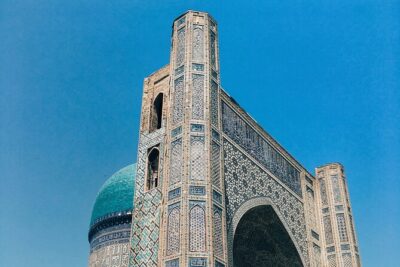
Samarkand City Tour with a Professional Photographer
Read our review →Browse the lists this tour appears in